
Cytonn Kenya’s Listed Banks Report Q1’2026, & Cytonn Weekly #24/2026
By Research Team, Jun 21, 2026
Executive Summary
Fixed Income
During the week, T-bills were oversubscribed for the third consecutive week, with the overall subscription rate coming in at 204.1%, higher than the subscription rate of 163.9%, recorded the previous week. Investors’ preference for the shorter 91-day paper persisted, with the paper receiving bids worth 36.8 bn against the offered Kshs 4.0 bn, translating to a subscription rate of 921.2%, higher than the subscription rate of 820.7%, recorded the previous week. The subscription rate for the 182-day paper decreased to 32.2% from 43.8% recorded the previous week, while that of the 364-day paper increased significantly to 89.2% from 21.4% recorded the previous week. The government accepted a total of Kshs 35.7 bn worth of bids out of Kshs 49.0 bn bids received, translating to an acceptance rate of 73.0%. The yields on the government papers were on an upward trajectory with the yields on the 182-day paper increasing the most by 17.8 bps to 8.8% from 8.6% recorded the previous week. The yield on the 91-day paper increased by 11.4 bps to 8.8% from 8.7% recorded the previous week, while the yield on the 364-day paper also increased by 10.3 bps to 9.0% from 8.9% recorded the previous week;
Also, during the week, the Central Bank of Kenya released the auction results for the re-opened treasury bonds FXD1/2018/020 and FXD1/2021/025 with tenors to maturities of 11.8 years and 20 years respectively and fixed coupon rates of 13.2% and 13.9% respectively. The bonds were oversubscribed, with the overall subscription rate coming in at 129.4%, receiving bids worth Kshs 77.6 bn against the offered Kshs 60.0 bn. The government accepted bids worth Kshs 42.6 bn, translating to an acceptance rate of 54.8%. The weighted average yields for the accepted bids for the FXD1/2018/020 and FXD1/2021/025 came in at 14.0%and 14.9% respectively. Notably, the 14.0% and 14.9% yields on FXD1/2018/020 and FXD1/2025/025 were both higher than the 13.9% and 13.4% recorded at the last reopening in October 2025 and February 2026 respectively;
The National Treasury gazetted the revenue and net expenditures for the eleventh month of FY’2025/2026, ending 29th May 2026, highlighting that the total revenue collected as at the end of May 2026 amounted to Kshs 2,324.8 bn, equivalent to 83.5% of the revised estimates of Kshs 2,784.4 bn for FY’2025/2026 and is 91.1% of the prorated estimates of Kshs 2,552.4 bn.
Equities
During the week, the equities market was on an upward trajectory, with NSE 10, NSE 25, NASI, and NSE 20 gaining by 6.6%, 5.1%, 4.2% and 2.9% respectively, taking the YTD performance to gains of 18.2%, 17.9%, 16.1% and 16.1% for NSE 25, NSE 10, NASI and NSE 20 respectively. The week-on-week equities market performance was mainly driven by gains recorded by large cap stocks such as EABL, ABSA and Equity of 9.3%, 9.0% and 6.0% respectively. However, the performance was weighed down by losses recorded by large cap stocks such as Stanbic, DTB-K and Standard Chartered of 1.2%, 0.5% and 0.1% respectively;
During the week, the banking sector index increased by 4.7% to 249.2 from 238.0 recorded the previous week. This is attributable to gains recorded by large cap stocks such Absa, Equity and KCB of 9.0%, 6.0% and 5.8% respectively. However, the performance was weighed down by losses recorded by large cap stocks such as Stanbic, DTB-K and Standard Chartered of 1.2%, 0.5% and 0.1% respectively;
During the week, Family Bank announced the listing of its 1,662,654,760 ordinary shares on the Main Investment Market Segment (MIMS) of the Nairobi Securities Exchange (NSE) through a Listing by Introduction on 23rd June 2026, at an introductory price of Kshs 18.0 per share;
During the week, Absa Group Limited announced its intention to acquire up to 896.0 mn additional ordinary shares in Absa Bank Kenya PLC through a tender offer to existing shareholders at a price of Kshs 34.5 per share;
Real Estate
During the week, the Government announced a Kshs 500.0 mn allocation for the reconstruction and upgrading of the deteriorated Imaroro–Isara Road network in Kajiado County under the newly established National Infrastructure Fund (NIF), reaffirming its commitment to accelerating infrastructure development through a blend of public and private sector financing;
During the week, the Government announced plans to raise more than Kshs 107.0 bn in debt financing to fund the modernization and expansion of Jomo Kenyatta International Airport (JKIA), a project expected to enhance Kenya's position as a regional aviation hub while supporting infrastructure-led economic growth;
During the week, Centum's dollar-denominated TRIFIC Green USD I-REIT successfully raised Kshs 3.86 bn, surpassing its target subscription and securing financing for the development of a green commercial office tower within the Two Rivers Special Economic Zone, signaling growing investor confidence in Kenya's REIT market;
On the Unquoted Securities Platform Acorn D-REIT and I-REIT traded at Kshs 29.6 and Kshs 23.8 per unit, respectively, as per the last updated data on 12th June 2026. The performance represented a 48.0% and 18.8% gain for the D-REIT and I-REIT, respectively, from the Kshs 20.0 inception price. Additionally, ILAM Fahari I-REIT traded at Kshs 13.8 per share as of 12th June 2026, representing a 31.0% loss from the Kshs 20.0 inception price;
Digital Payments
During the week, Fidelity Investments launched a new money market fund specifically designed for stablecoin issuers, providing regulated investment vehicles where issuers can hold reserve assets required to back digital payment tokens. The move comes as institutional asset managers increasingly compete for a growing market opportunity tied to reserve management services for stablecoin providers operating under stricter regulatory standards;
This week, Trace Finance announced a USD 32.0 mn Series A funding round aimed at scaling infrastructure that connects traditional banking systems with stablecoin-based settlement rails across markets including Brazil, the United States, and emerging economies. The company focuses on enabling regulated cross-border transactions where stablecoins can operate seamlessly alongside traditional banking infrastructure;
American Express Company has announced a proposed USD 700.0 mn all-cash acquisition of TheFork, a European restaurant reservation platform owned by Tripadvisor. The deal is part of American Express’s broader strategy to strengthen its presence in the global dining and premium lifestyle ecosystem, building on its previous investments in reservation and dining platforms such as Resy and Tock. TheFork connects users with more than 50,000 restaurants across 11 European countries, and the acquisition is expected to expand Amex’s global dining network to around 75,000 bookable venues. The transaction is expected to close by the end of 2026, subject to regulatory approvals and standard closing conditions.
The digital payment stocks we track (AXP, Visa, Mastercard, Circle, Block and Paypal) are currently trading at an average P/E of 26.2x, implying that investors are pricing in strong future earnings growth expectations and are willing to pay a significant premium for current earnings, which may also suggest that valuations may be stretched relative to near-term fundamentals;Bottom of Form
Focus of the Week
Following the release of the Q1’2026 results by Kenyan listed banks, the Cytonn Financial Services Research Team undertook an analysis on the financial performance of the listed banks and identified the key factors that shaped the performance of the sector.
Investment Updates:
- Weekly Rates: Cytonn Money Market Fund closed the week at a yield of 12.00% p.a. To invest, dial *809# or download the Cytonn App from Google Play store here or from the Appstore here.
- We continue to offer Wealth Management Training every Tuesday, from 7:00 pm to 8:00 pm. The training aims to grow financial literacy among the general public. To register for any of our Wealth Management Trainings, click here. If interested in our Private Wealth Management Training for your employees or investment group, please get in touch with us through wmt@cytonn.com.
- Cytonn Insurance Agency acts as an intermediary for those looking to secure their assets and loved ones’ future through insurance namely; Motor, Medical, Life, Property, WIBA, Credit and Fire and Burglary insurance covers. For assistance, get in touch with us through insuranceagency@cytonn.com.
- Cytonn Asset Managers Limited (CAML) continues to offer pension products to meet the needs of both individual clients who want to save for their retirement during their working years and Institutional clients that want to contribute on behalf of their employees to help them build their retirement pot. To more about our pension schemes, kindly get in touch with us through pensions@cytonn.com.
Hospitality Updates:
- We currently have promotions for Staycations. Visit cysuites.com/offers for details or email us at sales@cysuites.com.
Money Markets, T-Bills Primary Auction:
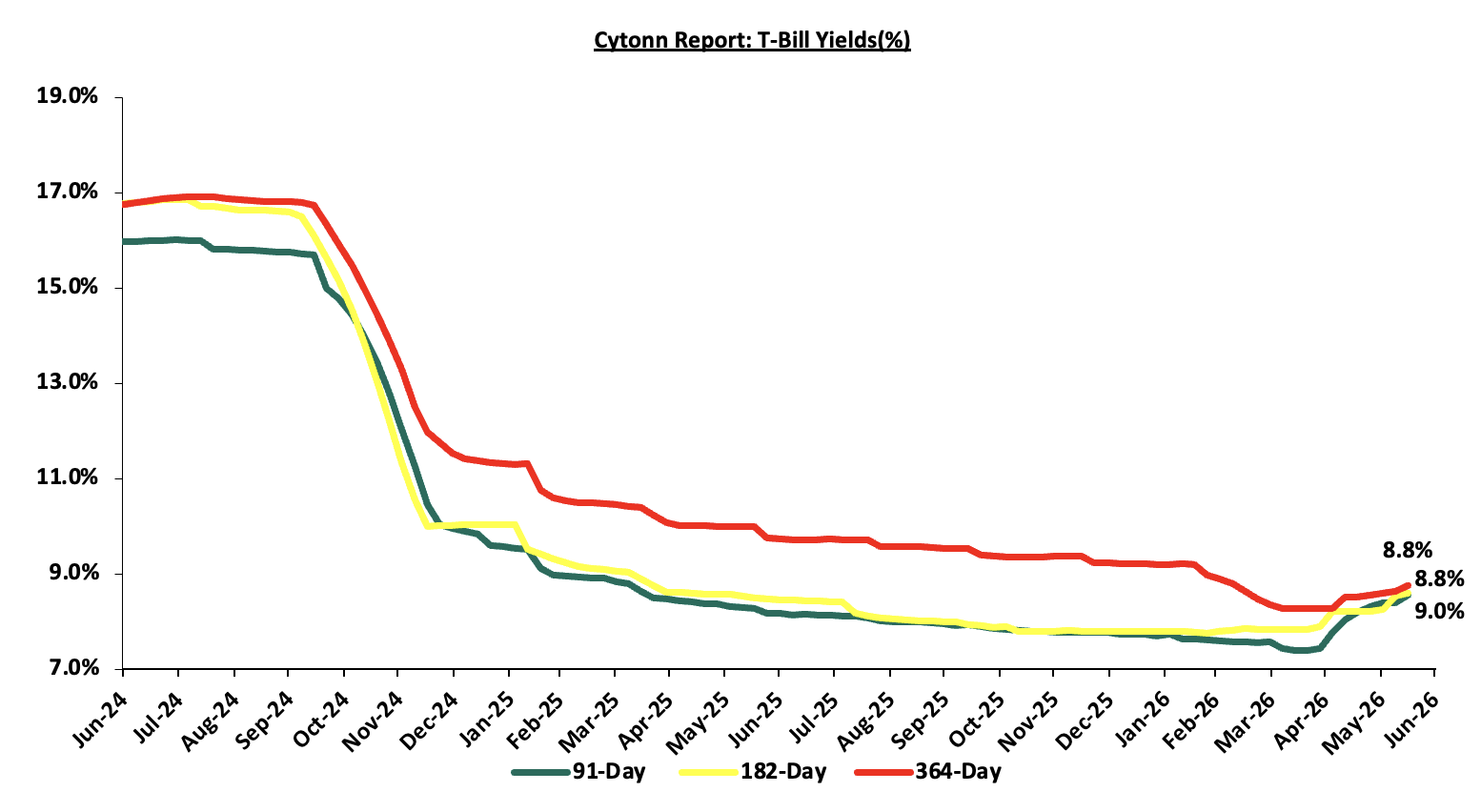
This week, T-bills were oversubscribed for the third consecutive week, with the overall subscription rate coming in at 204.1%, higher than the subscription rate of 163.9%, recorded the previous week. Investors’ preference for the shorter 91-day paper persisted, with the paper receiving bids worth 36.8 bn against the offered Kshs 4.0 bn, translating to a subscription rate of 921.2%, higher than the subscription rate of 820.7%, recorded the previous week. The subscription rate for the 182-day paper decreased to 32.2% from 43.8% recorded the previous week, while that of the 364-day paper increased significantly to 89.2% from 21.4% recorded the previous week. The government accepted a total of Kshs 35.7 bn worth of bids out of Kshs 49.0 bn bids received, translating to an acceptance rate of 73.0%. The yields on the government papers were on an upward trajectory with the yields on the 182-day paper increasing the most by 17.8 bps to 8.8% from 8.6% recorded the previous week. The yield on the 91-day paper increased by 11.4 bps to 8.8% from 8.7% recorded the previous week, while the yield on the 364-day paper also increased by 10.3 bps to 9.0% from 8.9% recorded the previous week. The chart below shows the yield growth rate for the 91-day paper from June 2025 to date:

The chart below shows the performance of the 91-day, 182-day and 364-day papers from June 2024 to June 2026:
The chart below compares the overall average T-bill subscription rates obtained in 2023, 2024, 2025 and 2026 Year-to-date (YTD):

T-Bonds Primary Auction:
This week, the Central Bank of Kenya released the auction results for the re-opened treasury bonds FXD1/2018/020 and FXD1/2021/025 with tenors to maturities of 11.8 years and 20 years respectively and fixed coupon rates of 13.2% and 13.9% respectively. The bonds were oversubscribed, with the overall subscription rate coming in at 129.4%, receiving bids worth Kshs 77.6bn against the offered Kshs 60.0 bn. The government accepted bids worth Kshs 42.6 bn, translating to an acceptance rate of 54.8%. The weighted average yield for the accepted bids for the FXD1/2018/020 and FXD1/2021/025 came in at 14.0%and 14.9% respectively. Notably, the 14.0% and 14.9% yields on FXD1/2018/020 and FXD1/2025/025 were both higher than the 13.9% and 13.4% recorded at the last reopening in October 2025 and February 2026 respectively.
Money Market Performance:
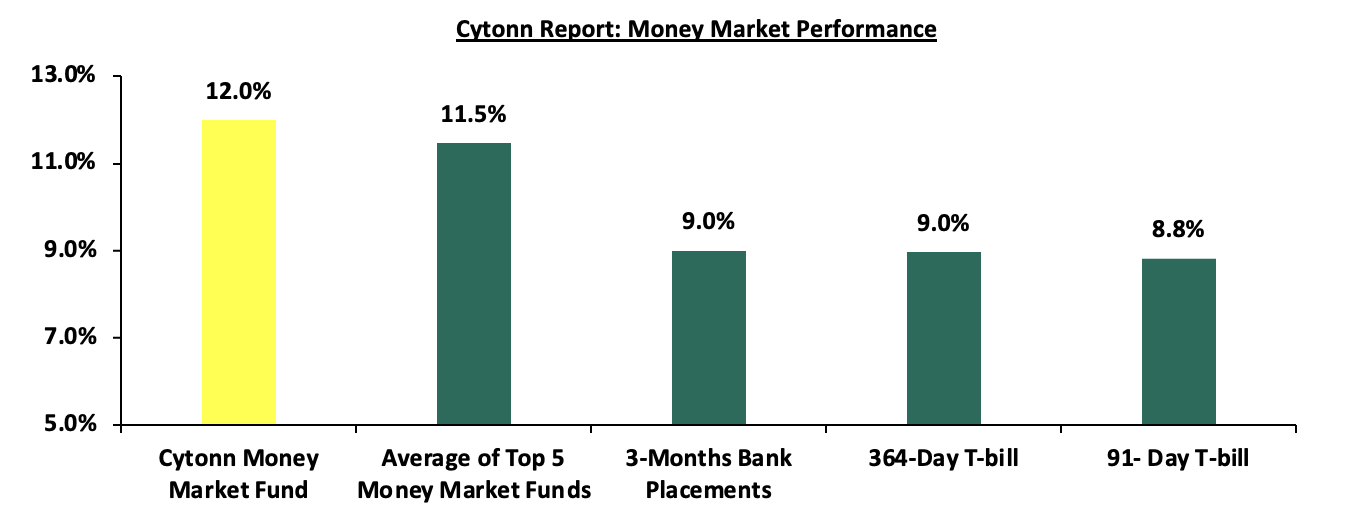
In the money markets, 3-month bank placements ended the week at 9.0% (based on rates offered by various banks. The yields on the government papers were on an upward trajectory with the yields on the 91-day paper increasing by 11.4 bps to 8.8% from 8.7% recorded the previous week, while the yield on the 364-day paper also increased by 10.3 bps to 9.0% from 8.9% recorded the previous week. The yield on the Cytonn Money Market Fund remained relatively unchanged from the 12.0% recorded the previous week, while the average yields on the Top 5 Money Market Funds increased by 10.6 bps to 11.5% from 11.4% recorded the previous week.
The table below shows the Money Market Fund Yields for Kenyan Fund Managers as published on 19th June 2026:
|
Money Market Fund Yield for Fund Managers as published on 19th June 2026 |
||
|
Rank |
Fund Manager |
Effective Annual Rate |
|
1 |
Nabo Africa Money Market Fund |
13.2% |
|
2 |
Cytonn Money Market Fund ( Dial *809# or download Cytonn App) |
12.0% |
|
3 |
Etica Money Market Fund |
11.0% |
|
4 |
Lofty-Corban Money Market Fund |
10.6% |
|
5 |
Enwealth Money Market Fund |
10.5% |
|
6 |
Ndovu Money Market Fund |
10.5% |
|
7 |
Madison Money Market Fund |
10.4% |
|
8 |
Arvocap Money Market Fund |
10.4% |
|
9 |
Kuza Money Market fund |
10.4% |
|
10 |
Faulu Money Market Fund |
10.4% |
|
11 |
Old Mutual Money Market Fund |
10.1% |
|
12 |
Gulfcap Money Market Fund |
10.1% |
|
13 |
Jubilee Money Market Fund |
10.0% |
|
14 |
Orient Kasha Money Market Fund |
10.0% |
|
15 |
British-American Money Market Fund |
9.7% |
|
16 |
Apollo Money Market Fund |
9.2% |
|
17 |
Dry Associates Money Market Fund |
9.1% |
|
18 |
GenAfrica Money Market Fund |
9.1% |
|
20 |
KCB Money Market Fund |
9.0% |
|
21 |
Genghis Money Market Fund |
8.9% |
|
22 |
SanlamAllianz Money Market Fund |
8.9% |
|
23 |
CIC Money Market Fund |
8.4% |
|
24 |
CPF Money Market Fund |
8.1% |
|
25 |
Mali Money Market Fund |
8.0% |
|
26 |
Co-op Money Market Fund |
8.0% |
|
27 |
Mayfair Money Market Fund |
7.7% |
|
28 |
ICEA Lion Money Market Fund |
7.6% |
|
29 |
Absa Shilling Money Market Fund |
7.1% |
|
30 |
Ziidi Money Market Fund |
6.0% |
|
31 |
AA Kenya Shillings Fund |
6.0% |
|
32 |
Stanbic Money Market Fund |
5.2% |
|
33 |
Equity Money Market Fund |
5.1% |
Source: Business Daily
Liquidity:
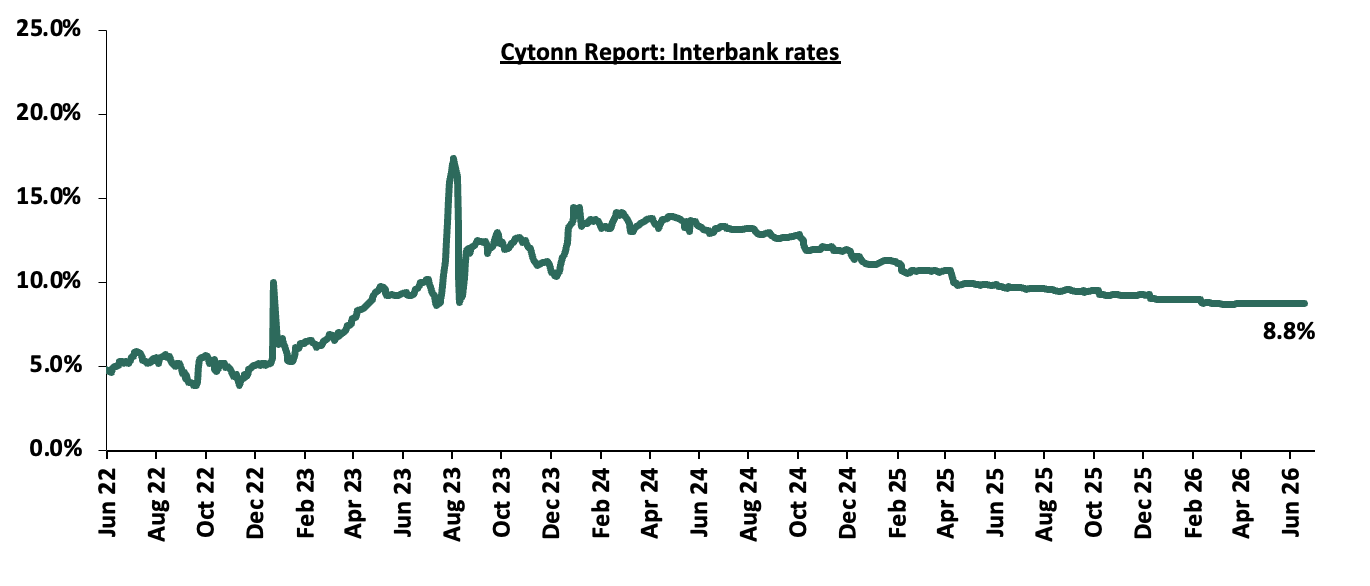
During the week, liquidity in the money markets tightened with the average interbank rate increasing marginally by 0.2 bps to 8.8% from 8.7% recorded last week, partly attributable to tax remittances that offset government payments. The average interbank volumes traded decreased significantly by 48.8% to Kshs 5.6 bn from Kshs 11.0 bn recorded the previous week. The chart below shows the interbank rates in the market over the years:
Kenya Eurobonds:
During the week, the yields on the Eurobonds were on a downward trajectory with the yield on the 7-year Eurobond issued in 2024, decreasing the most by 62.0 bps to 6.8% from 7.4% recorded the previous week. The table below shows the summary performance of the Kenyan Eurobonds as of 18th June 2026;
|
Cytonn Report: Kenya Eurobonds Performance |
||||||
|
|
2018 |
2019 |
2021 |
2024 |
||
|
Tenor |
10-year issue |
30-year issue |
12-year issue |
13-year issue |
7-year issue |
|
|
Amount Issued (USD) |
1.0 bn |
1.0 bn |
1.0 bn |
1.5 bn |
1.5 bn |
|
|
Years to Maturity |
2.5 |
22.5 |
8.8 |
5.5 |
10.5 |
|
|
Yields at Issue |
7.3% |
8.3% |
6.2% |
10.4% |
9.9% |
|
|
02-Jan-26 |
6.1% |
8.8% |
7.2% |
7.8% |
7.1% |
|
|
01-Jun-26 |
7.1% |
8.9% |
7.7% |
8.2% |
7.3% |
|
|
11-Jun-26 |
7.1% |
9.0% |
7.7% |
8.3% |
7.4% |
|
|
12-Jun-26 |
6.9% |
8.8% |
7.3% |
7.9% |
7.0% |
|
|
15-Jun-26 |
6.6% |
8.5% |
7.1% |
7.6% |
6.7% |
|
|
16-Jun-26 |
6.5% |
8.5% |
7.1% |
7.6% |
6.7% |
|
|
17-Jun-26 |
6.6% |
8.6% |
7.1% |
7.7% |
6.8% |
|
|
18-Jun-26 |
6.6% |
8.6% |
7.2% |
7.8% |
6.8% |
|
|
Weekly Change |
(0.5%) |
(0.4%) |
(0.6%) |
(0.5%) |
(0.6%) |
|
|
MTD Change |
(0.5%) |
(0.3%) |
(0.5%) |
(0.4%) |
(0.5%) |
|
|
YTD Change |
0.6% |
(0.2%) |
0.0% |
(0.0%) |
(0.3%) |
|
Source: Central Bank of Kenya (CBK) and National Treasury
Kenya Shilling:
During the week, the Kenya Shilling appreciated against the US Dollar by 14.7 bps to Kshs 129.5 from Kshs 129.7 recorded the previous week. On a year-to-date basis, the shilling has depreciated by 32.5 bps against the dollar, as compared to the 22.9 bps appreciation recorded in 2025.
We expect the shilling to be supported by:
-
Diaspora remittances standing at a cumulative USD 5,053.5 mn in the twelve months to April 2026, 1.1% higher than the USD 4,997.2 mn recorded over the same period in 2025. These have continued to cushion the shilling against further depreciation. In the April 2026 diaspora remittances figures, North America remained the largest source of remittances to Kenya accounting for 52.2% in the period, and,
-
Tourism inflows, which strengthened significantly. Tourism receipts reached Kshs 560.0 bn in 2025, up from Kshs 452.2 bn in 2024, representing a 23.9% increase, supported by improved international arrivals through the country’s major airports, and,
-
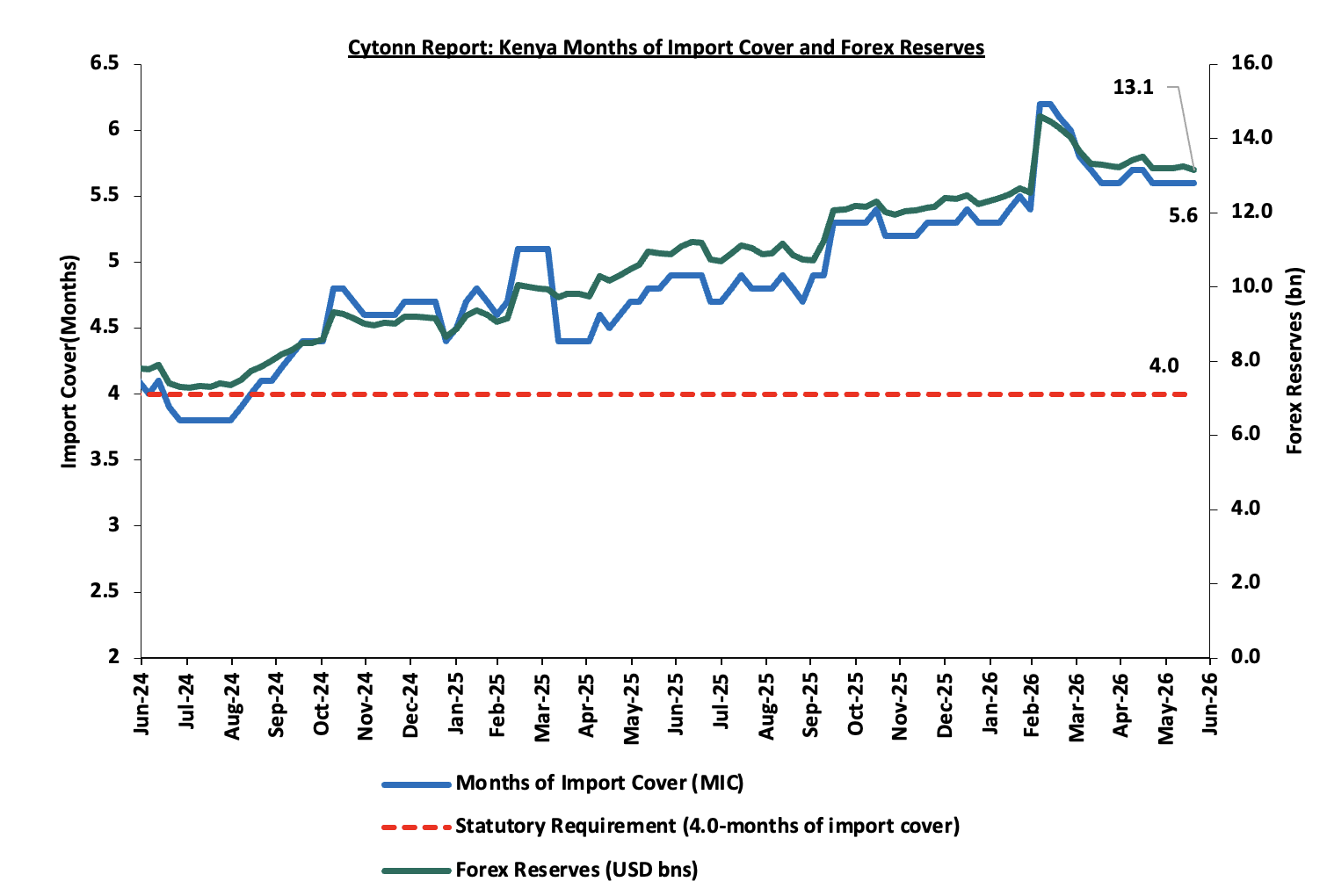
Improved forex reserves currently at USD 13.1 bn (equivalent to 5.6-months of import cover), which is above the statutory requirement of maintaining at least 4.0-months of import cover and above the EAC region’s convergence criteria of 4.5-months of import cover.
The shilling is however expected to remain under pressure in 2026 as a result of:
-
An ever-present current account deficit which came at 2.6% of GDP in the twelve months to April 2026, and,
-
The need for government debt servicing, continues to put pressure on forex reserves given that 52.0% of Kenya’s external debt is US Dollar-denominated as of September 2025.
-
Rising geopolitical tensions in the Middle East, which could exert pressure on the shilling through higher global oil prices and increased uncertainty in international markets. Given that Kenya is a net importer of petroleum products, any sustained increase in oil prices would widen the import bill, increase demand for US Dollars, and consequently put depreciation pressure on the shilling.
Kenya’s forex reserves decreased by 68.7 bps during the week to USD 13.1 bn from USD 13.2 bn recorded the previous week, equivalent to 5.6 months of import cover, and above the statutory requirement of maintaining at least 4.0-months of import cover.
The chart below summarizes the evolution of Kenya's months of import cover over the years:
Weekly Highlights
- Exchequer Highlight May 2026
The National Treasury gazetted the revenue and net expenditures for the eleventh month of FY’2025/2026, ending 29th May 2026, highlighting that the total revenue collected as at the end of May 2026 amounted to Kshs 2,324.8 bn, equivalent to 83.5% of the revised estimates of Kshs 2,784.4 bn for FY’2025/2026 and is 91.1% of the prorated estimates of Kshs 2,552.4 bn. Below is a summary of the performance:
|
Cytonn Report:FY'2025/2026 Budget Outturn - As at 29th May 2026 |
||||||
|
Amounts in Kshs billions unless stated otherwise |
||||||
|
Item |
12-months Original Estimates |
Revised Estimates |
Actual Receipts/Release |
Percentage Achieved |
Prorated |
% achieved of the Prorated |
|
Opening Balance |
6.4 |
|||||
|
Tax Revenue |
2,627.1 |
2,600.8 |
2,174.5 |
83.6% |
2,384.0 |
91.2% |
|
Non-Tax Revenue |
127.6 |
183.6 |
143.9 |
78.3% |
168.3 |
85.5% |
|
Total Revenue |
2,754.7 |
2,784.4 |
2,324.8 |
83.5% |
2,552.4 |
91.1% |
|
External Loans & Grants |
569.8 |
824.9 |
569.6 |
69.1% |
756.1 |
75.3% |
|
Domestic Borrowings |
1,098.3 |
1,539.1 |
1,179.3 |
76.6% |
1,410.8 |
83.6% |
|
Other Domestic Financing |
10.8 |
10.8 |
8.7 |
80.4% |
9.9 |
87.7% |
|
Total Financing |
1,678.9 |
2,374.8 |
1,757.5 |
74.0% |
2,176.9 |
80.7% |
|
Recurrent Exchequer issues |
1,470.4 |
1,676.6 |
1,457.4 |
86.9% |
1,536.9 |
94.8% |
|
CFS Exchequer Issues |
2,141.0 |
2,584.6 |
1,873.0 |
72.5% |
2,369.2 |
79.1% |
|
Development Expenditure & Net Lending |
407.1 |
483.0 |
383.5 |
79.4% |
442.7 |
86.6% |
|
County Governments + Contingencies |
415.0 |
415.0 |
346.5 |
83.5% |
380.4 |
91.1% |
|
Total Expenditure |
4,433.6 |
5,159.2 |
4,060.4 |
91.6% |
4,729.2 |
85.9% |
|
Fiscal Deficit excluding Grants |
1,678.9 |
2,374.8 |
1,735.7 |
73.1% |
2,176.9 |
79.7% |
|
Total Borrowing |
1,668.1 |
2,364.0 |
1,748.8 |
74.0% |
2,167.0 |
80.7% |
The key take-outs from the release include;
- Total revenue collected as at the end of May 2026 amounted to Kshs 2,324.8 bn, equivalent to 83.5% of the revised estimates of Kshs 2,784.4 bn for FY’2025/2026 and is 91.1% of the prorated estimates of Kshs 2,552.4 bn. Cumulatively, tax revenues amounted to Kshs 2,174.5 bn, equivalent to 83.6% of the revised estimates of Kshs 2,600.8 bn and 91.2% of the prorated estimates of Kshs 2,384.0 bn,
- Total financing amounted to Kshs 1,757.5 bn, equivalent to 74.0% of the revised estimates of Kshs 2,374.8 bn and is equivalent to 80.7% of the prorated estimates of Kshs 2,176.9 bn. Additionally, domestic borrowing amounted to Kshs 1,179.3 bn, equivalent to 76.6% of the revised estimates of Kshs 1,539.1 bn and is 83.6% of the prorated estimates of Kshs 1,410.8 bn.
- The total expenditure amounted to Kshs 4,060.4 bn, equivalent to 91.6% of the revised estimates of Kshs 5,159.2 bn, and is 85.9% of the prorated target expenditure estimates of Kshs 4,729.2 bn. Additionally, the net disbursements to recurrent expenditures came in at Kshs 1,457.4 bn, equivalent to 86.9% of the revised estimates of Kshs 1,676.6 and are equivalent to 94.8% of the prorated estimates of Kshs 1,536.9 bn,
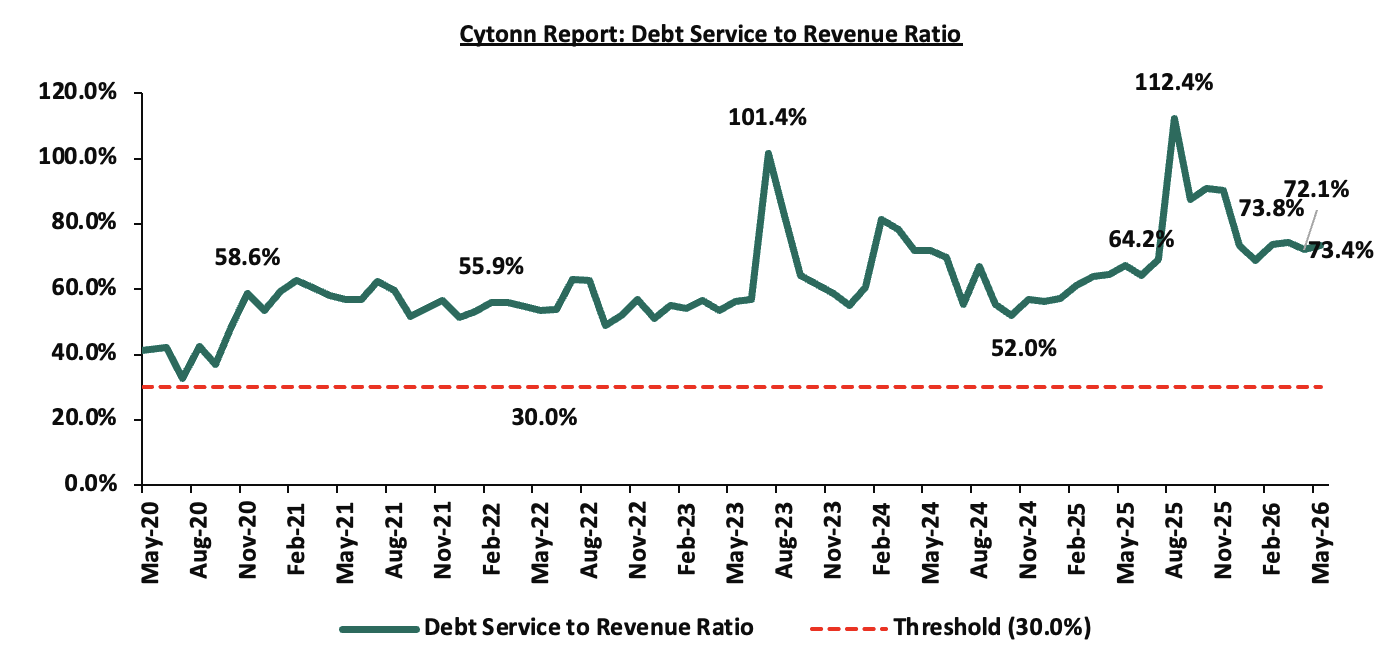
- Consolidated Fund Services (CFS) Exchequer issues came in at Kshs 1,873.0 bn, equivalent to 72.5% of the revised estimates of Kshs 2,584.6 bn, and are 72.5% of the prorated amount of Kshs 2,369.2 bn. The cumulative public debt servicing cost amounted to Kshs 1,707.5 bn which is 72.8% of the revised estimates of Kshs 2,344.6 bn and is 79.4% of the prorated estimates of Kshs 2,149.2 bn. Additionally, the Kshs 1,707.5 bn debt servicing cost is equivalent to 73.4% of the actual cumulative revenues collected as at the end of May 2026. The chart below shows the debt servicing cost to revenue ratio over the period;
- Total borrowings as at the end of May 2026 amounted to Kshs 1,748.8 bn, equivalent to 74.0% of the revised estimates of Kshs 2,364.0 bn for FY’2025/2026 and are 80.7% of the prorated estimates of Kshs 2,167.0 bn. The cumulative domestic borrowing of Kshs 1,539.1 bn comprises of Net Domestic Borrowing Kshs 994.8 bn and Internal Debt Redemptions (Rollovers) Kshs 544.3 bn.
The government underachieved its prorated revenue targets for the eleventh month of the FY’2025/2026, achieving 91.1% of the prorated revenue targets in May 2026, higher than 90.7% achieved in April 2026. This was driven by shortfall in tax revenues and non-tax revenues, which stood at 91.2% and 85.5% of prorated levels respectively, with collections amounting to Kshs 2,174.5 bn in tax revenue and Kshs 143.9 bn in non-tax revenue. External loans and grants were behind target at 69.1%, reducing reliance on domestic borrowing, which came in at 75.3% of the prorated target of Kshs 1,282.6 bn. The business environment, however, showed signs of deterioration, with the Purchasing Managers’ Index (PMI) standing at 46.6 in May 2026 from 49.4 in April 2026, remaining below the 50.0 neutral mark and signaling a contraction of business activity. Expenditure absorption stood at 85.9% of prorated levels, with development spending still lagging at 86.6%, reflecting slow implementation of capital projects. Future revenue performance will depend on how quickly private sector activity strengthens, supported by a stable Shilling, easing credit conditions following the decision to maintain the Central Bank Rate at 8.75% in June 2026, and continued efforts to broaden the tax base, curb evasion, and stimulate economic growth. However, the outlook remains vulnerable to external shocks, particularly the ongoing Iran-Israel conflict, which has heightened global oil price volatility and supply chain disruptions, posing upside risks to inflation and production costs, and potentially constraining private sector expansion and revenue mobilization.
Rates in the Fixed Income market have been on an upward trend due to tightened liquidity in the money market which has limited the government to front load most of its borrowing. The government is 25.2% ahead of its prorated net domestic borrowing target of Kshs 976.7 bn, having a net borrowing position of Kshs 1223.2 bn (inclusive of T-bills). However, we expect the yield curve to steepen in the short and medium term, driven by the inflationary pressure, with the government looking to increase its domestic borrowing to maintain the fiscal surplus. As such, we expect the yield curve to steepen in the short to medium-term and hence investors are expected to shift towards the short to medium-term papers to lock in the high returns.
Market Performance:
During the week, the equities market was on an upward trajectory, with NSE 10, NSE 25, NASI, and NSE 20 gaining by 6.6%, 5.1%, 4.2% and 2.9% respectively, taking the YTD performance to gains of 18.2%, 17.9%, 16.1% and 16.1% for NSE 25, NSE 10, NASI and NSE 20 respectively. The week-on-week equities market performance was mainly driven by gains recorded by large cap stocks such as EABL, ABSA and Equity of 9.3%, 9.0% and 6.0% respectively. However, the performance was weighed down by losses recorded by large cap stocks such as Stanbic, DTB-K and Standard Chartered of 1.2%, 0.5% and 0.1% respectively.
During the week, the banking sector index increased by 4.7% to 249.2 from 238.0 recorded the previous week. This is attributable to gains recorded by large cap stocks such Absa, Equity and KCB of 9.0%, 6.0% and 5.8% respectively. However, the performance was weighed down by losses recorded by large cap stocks such as Stanbic, DTB-K and Standard Chartered of 1.2%, 0.5% and 0.1% respectively.
During the week, equities turnover increased by 87.7% to USD 49.8 mn from USD 26.5 mn recorded the previous week, taking the YTD total turnover to USD 783.8 mn. Foreign investors became net sellers for the first time in two weeks with a net selling position of USD 0.2 mn, from a net buying position of USD 3.5 mn recorded the previous week, taking the YTD foreign net selling position to USD 79.6 mn, compared to a net selling position of USD 92.9 mn recorded in 2025;
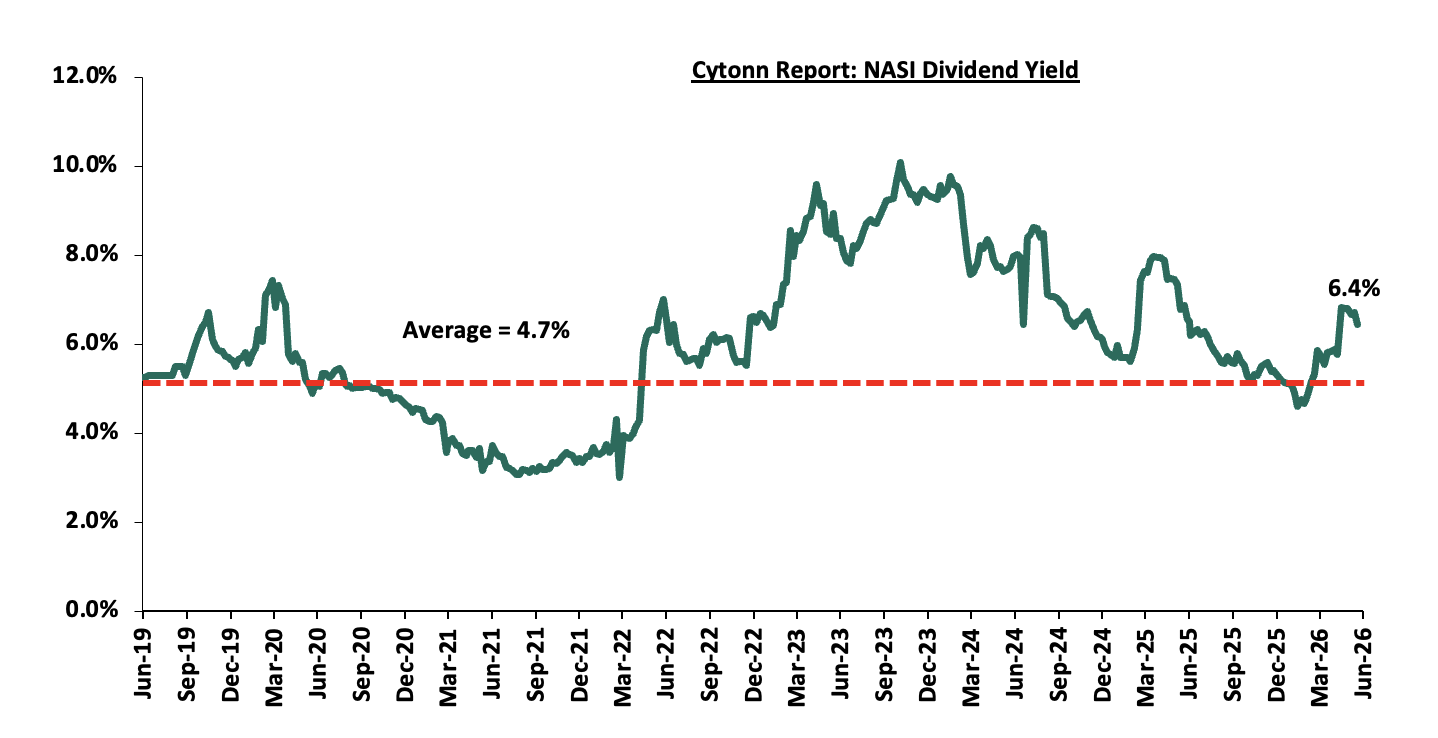
The market is currently trading at a price to earnings ratio (P/E) of 6.9x, 38.5% below the historical average of 11.2x, and a dividend yield of 6.4%, 1.7% points above the historical average of 4.7%. Key to note, NASI’s PEG ratio currently stands at 0.9x, an indication that the market is slightly undervalued relative to its future growth. A PEG ratio greater than 1.0x indicates the market may be overvalued while a PEG ratio less than 1.0x indicates that the market is undervalued;
The charts below indicate the historical P/E and dividend yields of the market:

Universe of Coverage:
|
Cytonn Report: Equities Universe of Coverage |
|||||||||||
|
Company |
Price as at 12/06/2026 |
Price as at 19/06/2026 |
w/w change |
m/m change |
YTD Change |
Year Open 2026 |
Target Price* |
Dividend Yield |
Upside/ Downside** |
P/TBv Multiple |
Recommendation |
|
CIC Group |
4.2 |
4.2 |
0.2% |
0.5% |
(7.3%) |
4.5 |
5.5 |
3.1% |
33.7% |
1.1x |
Buy |
|
NCBA |
88.3 |
90.0 |
2.0% |
3.2% |
5.9% |
85.0 |
108.9 |
7.9% |
28.9% |
1.2x |
Buy |
|
ABSA Bank |
28.2 |
30.8 |
9.0% |
7.0% |
23.7% |
24.9 |
36.8 |
6.7% |
26.5% |
1.7x |
Buy |
|
KCB Group |
69.3 |
73.3 |
5.8% |
9.7% |
11.4% |
65.8 |
83.9 |
9.6% |
24.2% |
0.8x |
Buy |
|
Diamond Trust Bank |
142.5 |
141.8 |
(0.5%) |
(3.7%) |
23.5% |
114.8 |
161.4 |
6.3% |
20.2% |
0.4x |
Buy |
|
Co-op Bank |
31.7 |
33.3 |
5.0% |
3.7% |
39.3% |
23.9 |
36.9 |
7.5% |
18.4% |
1.2x |
Accumulate |
|
Jubilee Holdings |
368.0 |
360.3 |
(2.1%) |
(1.9%) |
11.7% |
322.5 |
407.5 |
4.2% |
17.3% |
0.5x |
Accumulate |
|
Equity Group |
75.5 |
80.0 |
6.0% |
7.7% |
19.4% |
67.0 |
87.5 |
7.2% |
16.5% |
1.0x |
Accumulate |
|
Standard Chartered Bank |
337.0 |
336.8 |
(0.1%) |
1.1% |
12.3% |
299.8 |
345.8 |
9.2% |
11.9% |
2.1x |
Accumulate |
|
Britam |
12.4 |
12.4 |
0.4% |
0.8% |
36.9% |
9.1 |
13.5 |
0.0% |
8.9% |
0.9x |
Hold |
|
I&M Group |
55.0 |
61.8 |
12.3% |
21.7% |
44.3% |
42.8 |
56.4 |
6.1% |
(2.6%) |
1.0x |
Sell |
|
Stanbic Holdings |
292.5 |
289.0 |
(1.2%) |
7.2% |
46.1% |
197.8 |
250.9 |
7.7% |
(5.4%) |
1.6x |
Sell |
|
*Target Price as per Cytonn Analyst estimates **Upside/ (Downside) is adjusted for Dividend Yield ***Dividend Yield is calculated using FY’2025 Dividends |
|||||||||||
Weekly Highlights
-
Family Bank to Join NSE Main Market on 23rd June through Listing by Introduction
Family Bank is set to list its 1,662,654,760 ordinary shares on the Main Investment Market Segment (MIMS) of the Nairobi Securities Exchange (NSE) through a Listing by Introduction on 23rd June 2026, at an introductory price of Kshs 18.0 per share. The listing price represents a 39.2% discount to the bank’s weighted fair value estimate of Kshs 29.6 per share and implies a price-to-book (P/B) ratio of 0.9x. On an earnings basis, the introduction price translates to a P/E ratio of 4.6x based on FY'2025 reported EPS of Kshs 3.9. Even when adjusted for non-recurring items using the FY'2025 core EPS of Kshs 3.2, the stock trades at an implied P/E ratio of 5.6x, suggesting an attractive valuation relative to the bank's recent growth trajectory. The listing follows approval by the Capital Markets Authority (CMA) and will make Family Bank the 11th banking sector counter listed on the Nairobi Securities Exchange (NSE), expanding investment opportunities within one of the exchange's most significant sectors.
The listing comes as the lender continues to post strong financial growth. Total assets increased by 23.8% to Kshs 208.7 bn in FY’2025 from Kshs 168.5 bn in FY’2024, while shareholder’s funds increased by 42.2% to Kshs 32.6 bn from Kshs 22.4 bn in FY’2024. Profit after tax more than doubled to Kshs 5.4 bn from Kshs 2.3 bn, supported by improved operational efficiency, with the cost-to-income ratio declining to 58.9% from 69.2% in FY'2024. Return on average equity (ROaE) improved to 19.6% from 17.6% in FY’2024, underscoring the bank's ability to generate stronger returns for shareholders. The bank has also maintained a commitment to shareholder returns, paying a dividend of Kshs 1.2 per share in FY'2025, translating to a payout ratio of 41.0%. Based on the introductory price, this implies a dividend yield of approximately 6.7%, making the stock potentially attractive to income-seeking investors while still allowing the bank to retain earnings to support future growth initiatives. The bank's core capital stood at Kshs 26.0 bn as at March 2026, more than double the upcoming Kshs 10.0 bn regulatory minimum requirement due by 2032, positioning it comfortably ahead of the sector's recapitalization timeline.
Despite the strong earnings growth, asset quality remains a key area to monitor. The gross non-performing loan (NPL) ratio increased to 14.8% in FY'2025 from 13.9% in FY'2024 and remained elevated at 14.3% in Q1'2026, highlighting persistent credit risks within the operating environment.
Family Bank's shareholder register is anchored by institutional and long-term investors, with Kenya Tea Development Agency Holdings holding a 19.0% stake, followed by the Estate of Rachael Njeri Muya at 10.1% and Daykio Plantations Limited at 9.5%. The diversified ownership structure is expected to support market confidence as the bank transitions into a publicly traded company. Below is a summary of Family Bank’s shareholding as of 31st December 2025
|
Cytonn Report: Family Bank Shareholding as of 31st December 2025 |
||
|
Owner |
No of Share |
Percentage |
|
KENYA TEA DEVELOPMENT AGENCY (HOLDINGS) LTD |
315,633,181 |
19.0% |
|
ESTATE OF RACHAEL NJERI MUYA |
167,143,948 |
10.1% |
|
DAYKIO PLANTATIONS LIMITED |
158,460,364 |
9.5% |
|
INVESTMENTS & MORTGAGES NOMINEE LIMITED A/C 008243 |
81,265,517 |
4.9% |
|
TITUS KIONDO MUYA |
73,408,502 |
4.4% |
|
EQUITY NOMINEES LIMITED A/C 00084 |
46,417,000 |
2.8% |
|
NCBA CUSTODIAL SERVICES A/C 234 |
36,034,335 |
2.2% |
|
KENYA ORIENT LIFE ASSURANCE LIMITED |
35,341,900 |
2.1% |
|
NCBA CUSTODIAL SERVICES A/C 325 |
34,883,448 |
2.1% |
|
EQUITY NOMINEES LIMITED A/C00132 |
34,482,000 |
2.1% |
|
OTHER SHAREHOLDERS |
679,584,565 |
40.9% |
|
TOTAL |
1,662,654,760 |
100.0% |
Source: Family Bank’s FY’2025 Annual Report
|
Cytonn Report: Summary of Key Details of the Family Bank NSE Listing |
|
|
Item |
Details |
|
Transaction Type |
Listing by Introduction |
|
No. of Authorized Shares |
2,300,000,000 |
|
Shares to be listed (No of issued and fully paid-up shares) |
|
|
Par Value |
Kshs 1.0 |
|
Introduction Price per share |
Kshs 18.0 |
|
Implied dividend yield (based on FY’2025 DPS of Kshs 1.2) |
6.7% |
|
Implied Market Capitalization |
Kshs 29.9 bn |
|
Listing Segment |
NSE Main Investment Market Segment |
|
Commencement of trading at NSE |
23rd June 2026 |
Overall, beyond providing investors with exposure to one of Kenya's fastest-growing tier-two lenders, the NSE listing is expected to enhance Family Bank's visibility, strengthen corporate governance and disclosure standards, and improve liquidity for existing shareholders. As the 11th listed banking counter on the NSE and one of the few major equity listings in recent years, the transaction could help reinvigorate activity in Kenya's equity capital markets and encourage other well-capitalized mid-tier banks to consider public listings as a pathway to greater market visibility, shareholder liquidity and future capital access.
-
Absa Group Seeks to Increase Stake in Absa Kenya Through Tender Offer
Absa Group Limited has announced its intention to acquire up to 896.0 mn additional ordinary shares in Absa Bank Kenya PLC through a tender offer to existing shareholders at a price of Kshs 34.5 per share. If fully subscribed, the transaction will increase Absa Group's shareholding to 4.6 bn ordinary shares, representing 85.0%, from 3.7 bn ordinary shares, representing 68.5% of the issued share capital. The proposed acquisition has received approval from the Central Bank of Kenya (CBK) and the Prudential Authority of South Africa, and is subject to approval by the Capital Markets Authority (CMA). Absa Group has also applied for an exemption from the takeover provisions of the Capital Markets (Take-Overs and Mergers) Regulations, noting that the transaction is intended to increase its shareholding in the bank rather than result in a takeover. Subject to CMA approval, the offer will open for a single offer period of 30 business days, commencing on 30th June 2026 and closing on 11th August 2026, with Absa Group indicating that Absa Bank Kenya will remain listed on the Nairobi Securities Exchange (NSE) upon completion of the transaction.
The offer price represents a 18.2% premium to Absa Bank Kenya's closing share price of Kshs 29.2 as of 17th June 2026. The offer also represents premiums of 20.0%, 18.9% and 28.2% to the 30-day, 90-day and 180-day volume-weighted average prices up to 17th June 2026 ( the last trading day before the tender offer was submitted) , respectively, highlighting Absa Group's willingness to pay above prevailing market prices to increase its ownership stake.
Based on the proposed acquisition of 895,989,600 shares at Kshs 34.5 per share, the transaction is valued at approximately Kshs 30.9 bn, making it one of the largest shareholder transactions in the Kenyan banking sector in recent years. The offer price implies a P/E ratio of 8.2x based on FY'2025 earnings, suggesting that Absa Group views the Kenyan subsidiary as an attractive long-term investment despite the premium being offered to minority shareholders.
According to Absa Group, the acquisition aligns with its strategy of deepening its presence in high-growth African markets and reflects its confidence in the long-term prospects of Absa Kenya, the Kenyan banking sector and the broader East African economy. The Group has further indicated that it intends to maintain Absa Bank Kenya's NSE listing following completion of the transaction.
Overall, the proposed tender offer signals strong confidence by Absa Group in the future earnings potential of its Kenyan subsidiary. The premium offered provides minority shareholders with an opportunity to realize value above prevailing market prices, while the transaction could improve strategic alignment between Absa Group and Absa Kenya. The move also demonstrates continued foreign investor confidence in Kenya's banking sector and capital markets, particularly given the significant premium being offered despite prevailing market uncertainties.
We maintain a “cautiously optimistic” short-term outlook supported primarily earnings-led attractive valuations, despite rising yields on short-term government papers, which increase competition for capital by drawing investors towards risk-free government securities, as well as heightened geopolitical risks such as Iran war that may weigh on investor sentiment, and, “neutral” in the long term as persistent foreign investor outflows continue to constrain market liquidity and limit broad-based market re-rating. With the market currently trading at a discount to its future growth (PEG Ratio at 0.9x), where performance will be driven by company-specific fundamentals rather than general market direction, we believe that investors should reposition towards value stocks exhibiting strong earnings growth, attractive dividend yields, solid balance sheets, sustainable competitive advantages and trading at compelling discounts to their intrinsic value. While foreign investor sell-offs are expected to continue exerting pressure in the near term, we believe this will create selective entry opportunities for long-term investors.
-
Infrastructure Sector
During the week, the Government announced a Kshs 500.0 mn allocation for the reconstruction of the deteriorated Imaroro–Isara Road in Kajiado County, a key transport corridor connecting Kajiado West, Kajiado Central and Kajiado East constituencies. The announcement was made by President William Ruto during a church fundraiser in Kiserian, with the project set to be financed under the newly established National Infrastructure Fund (NIF). The fund, which currently holds approximately Kshs 100.0 bn from the Kenya Pipeline Company Initial Public Offering (IPO) and is projected to grow to Kshs 300.0 bn, is expected to leverage both public and private capital to accelerate the development of critical infrastructure projects across the country.
The Imaroro–Isara Road forms part of a 230-kilometre low-volume seal road network developed in phases from 2020 to improve accessibility and facilitate economic activity within Kajiado County. However, the road has experienced significant deterioration over recent years due to increased usage by overloaded sand transport trucks and delays in routine maintenance and resealing works. The poor condition of the road has adversely affected mobility, increased transportation costs, and disrupted commercial activities for residents and businesses that rely on the corridor.
In addition to the reconstruction works, the Government indicated that part of the allocation will support upgrades on other strategic roads within the county, including the Illasit–Njukini–Taveta and Cooperative–Bulbul roads. The announcement was accompanied by plans to invest approximately Ksh 23.0 bn in affordable housing projects, markets, and student accommodation facilities within the county. Construction of the Mashuru–Isara section is expected to commence next month, while the road network has since been reclassified and transferred from the Kenya Rural Roads Authority (KeRRA) to the Kenya National Highways Authority (KeNHA) for management and upgrading.
Going forward, the reconstruction and upgrading of the Kajiado road network is expected to improve connectivity, reduce travel times, and lower transportation costs for residents and businesses within the county. Improved road infrastructure is likely to stimulate economic activity, enhance access to markets and social services, and support the movement of goods across the region. For the Real Estate sector, enhanced accessibility could increase the attractiveness of surrounding areas for residential, commercial, and mixed-use developments while supporting land value appreciation and encouraging private sector investment. Additionally, the use of the National Infrastructure Fund highlights the government's growing shift towards alternative infrastructure financing mechanisms, which could accelerate the delivery of critical projects while reducing pressure on public finances.
During the week, the Government announced plans to finance the expansion and modernization of Jomo Kenyatta International Airport (JKIA) through a blended funding structure combining debt financing, airport-generated revenues, and support from the National Infrastructure Fund (NIF). The Ministry of Roads and Transport indicated that the project will cost up to Ksh 154.2 bn, with approximately 70.0% of the funding, equivalent to about Kshs 107.0 bn, expected to be raised through debt financing. The remaining 30.0% will be financed through airport-based revenues and equity contributions, including potential participation from the NIF.
The Government has appointed the Trade Development Bank (TDB) and the Africa Finance Corporation (AFC) as lead arrangers to structure the financing model and mobilize additional capital from commercial lenders and institutional investors. According to the Ministry, the NIF is expected to contribute a portion of the equity component to lower financing costs and reduce project risk, reflecting the Government's broader strategy of leveraging alternative financing mechanisms to support large-scale infrastructure development while easing pressure on public finances.
The proposed expansion seeks to transform JKIA into a leading regional aviation hub by significantly increasing passenger handling capacity. The project will increase existing terminal capacity from 7.5 mn passengers annually to 12.0 mn passengers, while a new terminal will accommodate an additional 10.0 mn passengers per year, bringing total annual capacity to more than 22.0 mn passengers over the long term. The project will also include rehabilitation and upgrading of existing airport infrastructure, with construction of the new terminal expected to take approximately 36 months and airfield rehabilitation projected to take 15 months.
Going forward, the expansion of JKIA is expected to strengthen Kenya's position as a regional transport and logistics hub while supporting tourism, trade, and investment inflows. Improved airport infrastructure could enhance connectivity and facilitate increased passenger and cargo traffic, creating positive spillover effects across multiple sectors of the economy. For the Real Estate sector, improved aviation infrastructure is likely to support demand for hospitality, commercial office space, logistics facilities, warehousing, and mixed-use developments within Nairobi and surrounding growth corridors. Additionally, the adoption of a blended financing model involving the National Infrastructure Fund and development finance institutions reinforces the government's growing shift toward alternative infrastructure financing mechanisms, which could accelerate delivery of strategic projects while maintaining fiscal sustainability.
-
Real Estate Investments Trusts
During the week, Centum's dollar-denominated TRIFIC Green USD I-REIT successfully raised Kshs 3.9 bn (USD 29.8 mn), achieving its fundraising target and unlocking financing for the development of a sustainable commercial office building within the Two Rivers Special Economic Zone (SEZ). The offer attracted investor bids worth Kshs 3.99 bn, representing an oversubscription rate of 103.3%, highlighting strong investor demand for income-generating Real Estate investment products. As part of the transaction, TRIFIC transferred the TRIFIC North Tower into the fund as its seed asset and acquired units worth Kshs 966.1 mn.
The TRIFIC North Tower comprises approximately 16,234 SQM of lettable space and currently enjoys an occupancy rate of about 90.0%, with tenants primarily consisting of international business services firms. The fund is expected to generate returns of approximately 8.0% through long-term lease agreements featuring annual rental escalations, providing investors with stable income streams while preserving value against inflationary pressures. The successful fundraising underscores increasing investor confidence in professionally managed, income-generating Real Estate assets backed by strong occupancy levels and high-quality tenants.
The TRIFIC Green USD I-REIT is the second dollar-denominated REIT in Kenya following the launch of the African Logistics Properties REIT earlier this year. The fund is scheduled to list on the Nairobi Securities Exchange (NSE) at a valuation of approximately Kshs 4.8 bn, expanding the range of foreign-currency denominated investment products available within Kenya's capital markets. The structure is also aligned with sustainable development objectives through investment in environmentally friendly commercial Real Estate assets.
Going forward, the successful subscription of the TRIFIC Green USD I-REIT is expected to boost confidence in Kenya's REIT market and support broader efforts to deepen capital market participation in Real Estate financing. The strong investor appetite demonstrated by the offer highlights growing demand for institutional-grade, income-generating assets that provide stable returns and foreign currency exposure. For the Real Estate sector, increased uptake of REIT products could improve access to long-term development capital, facilitate the delivery of large-scale commercial and mixed-use projects, and promote greater adoption of sustainable building practices. Additionally, the continued growth of dollar-denominated REITs may attract both local and international investors seeking diversification and protection against currency volatility, further strengthening Kenya's position as a regional Real Estate investment destination.
-
REITs Weekly Performance
On the Unquoted Securities Platform Acorn D-REIT and I-REIT traded at Kshs 29.6 and Kshs 23.8 per unit, respectively, as per the last updated data on 12th June 2026. The performance represented a 48.0% and 18.8% gain for the D-REIT and I-REIT, respectively, from the Kshs 20.0 inception price. The volumes traded for the D-REIT and I-REIT came in at 13.5 mn and 43.9 mn shares, respectively. Additionally, ILAM Fahari I-REIT traded at Kshs 13.8 per share as of 12th June 2026, representing a 31.0% loss from the Kshs 20.0 inception price. The volume traded to date came in at 1.2 mn shares for the I-REIT, REITs offer various benefits, such as tax exemptions, diversified portfolios, and stable long-term profits. However, the ongoing decline in the performance of Kenyan REITs and the restructuring of their business portfolios are hindering significant previous investments. Additional general challenges include:
-
Insufficient understanding of the investment instrument among investors leading to a slower uptake of REIT products,
-
Lengthy approval processes for REIT creation,
-
High minimum capital requirements of Kshs 100.0 mn for REIT trustees compared to Kshs 10.0 mn for pension funds Trustees, essentially limiting the licensed REIT Trustee to banks only
-
The rigidity of choice between either a D-REIT or and I-REIT forces managers to form two REITs, rather than having one Hybrid REIT that can allocate between development and income earning properties
-
Limiting the type of legal entity that can form a REIT to only a trust company, as opposed to allowing other entities such as partnerships, and companies,
-
We need to give time before REITS are required to list – they would be allowed to stay private for a few years before the requirement to list given that not all companies maybe comfortable with listing on day one, and,
-
Minimum subscription amounts or offer parcels set at Kshs 0.1 mn for D-REITs and Kshs 5.0 mn for restricted I-REITs. The significant capital requirements still make REITs relatively inaccessible to smaller retail investors compared to other investment vehicles like unit trusts or government bonds, all of which continue to limit the performance of Kenyan REITs.
We expect the performance of Kenya's Real Estate sector to remain resilient, supported by several factors: i) Government allocating KShs 500.0mn for reconstruction of Kajiado road network ii) JKIA expansion through debt and infrastructure funding; and iii) Centum's TRIFIC Green USD I-REIT achieves full subscription. However, challenges such the weak investor appetite in listed REITs like ILAM Fahari I-REIT and high capital requirements will continue to constrain the sector's optimal performance.
Digital Payments Weekly Highlights
-
Fidelity Launches Money Market Fund Targeting Stablecoin Reserve Management
During the week, Fidelity Investments launched a new money market fund specifically designed for stablecoin issuers, providing regulated investment vehicles where issuers can hold reserve assets required to back digital payment tokens. The move comes as institutional asset managers increasingly compete for a growing market opportunity tied to reserve management services for stablecoin providers operating under stricter regulatory standards.
The significance is that traditional financial institutions are increasingly building supporting infrastructure around stablecoins, not just participating in issuance. Stablecoin reserve management represents a major emerging financial services segment, and Fidelity’s move signals that stablecoins are creating entirely new institutional business models spanning custody, treasury management, compliance services, and liquidity management. This reflects the growing integration of digital assets into mainstream capital markets infrastructure.
-
Trace Finance Raises USD 32.0 Mn to Connect Stablecoins With Traditional Banking Infrastructure
This week, Trace Finance announced a USD 32.0 mn Series A funding round aimed at scaling infrastructure that connects traditional banking systems with stablecoin-based settlement rails across markets including Brazil, the United States, and emerging economies. The company focuses on enabling regulated cross-border transactions where stablecoins can operate seamlessly alongside traditional banking infrastructure.
The significance of this development is that investment capital is increasingly flowing toward companies building infrastructure rather than speculative crypto products. This suggests the market is entering a maturation phase where the focus is shifting from token issuance toward practical enterprise applications, particularly cross-border payments. For the digital payments sector, infrastructure providers like Trace Finance may play an important role in integrating blockchain settlement into existing financial systems without requiring a complete replacement of traditional banking rails.
-
American Express to Acquire TheFork for USD 700.0 mn to Expand Dining Ecosystem
American Express Company has announced a proposed USD 700.0 mn all-cash acquisition of TheFork, a European restaurant reservation platform owned by Tripadvisor. The deal is part of American Express’s broader strategy to strengthen its presence in the global dining and premium lifestyle ecosystem, building on its previous investments in reservation and dining platforms such as Resy and Tock. TheFork connects users with more than 50,000 restaurants across 11 European countries, and the acquisition is expected to expand Amex’s global dining network to around 75,000 bookable venues. The transaction is expected to close by the end of 2026, subject to regulatory approvals and standard closing conditions.
The acquisition reflects American Express’s continued shift toward becoming a lifestyle and experiences-driven financial services platform rather than just a payments provider. By owning and integrating restaurant discovery and booking infrastructure, Amex can deepen cardholder engagement, increase transaction frequency in high-spend categories like dining and travel, and strengthen loyalty within its premium customer base. This move also reinforces the company’s international growth strategy, particularly in Europe, where TheFork has a strong footprint, and enhances Amex’s ability to control more of the end-to-end customer experience, from discovery to payment.
-
Digital Payments Stock Performance
The table below presents a snapshot of NYSE-listed digital payments stocks, covering Visa, Mastercard, American Express (AXP), Circle, Block and Paypal.
|
Cytonn Report: Digital Payments NYSE stock perfomance |
||||||
|
Company |
Year Open 2026 |
Price 6/12/2026 |
Price 6/19/2026 |
w/w change |
YTD change |
P/E |
|
American Express |
372.7 |
325.4 |
338.0 |
3.9% |
(9.3%) |
27.4x |
|
Visa |
346.5 |
322.4 |
327.2 |
1.5% |
(5.6%) |
16.5x |
|
Mastercard |
563.1 |
490.0 |
489.8 |
(0.0%) |
(13.0%) |
30.5x |
|
Circle |
83.5 |
77.8 |
80.2 |
3.1% |
(3.9%) |
44.1x |
|
Block |
65.2 |
69.5 |
74.8 |
7.6% |
14.8% |
31.0x |
|
Paypal Holdings |
58.1 |
41.5 |
42.5 |
2.4% |
(26.9%) |
7.7x |
|
Average |
|
|
|
|
|
26.2x |
Source: Visa, AXP, Circle, Mastercard, Block and Paypal financials. NYSE
The stocks are currently trading at an average P/E multiple of 26.2x, indicating that investors are pricing in strong future earnings growth and are prepared to pay a substantial premium for current earnings. This also suggests that valuations may be stretched relative to near-term fundamentals.
We expect the global digital payments sector to continue undergoing a structural transformation driven by the convergence of stablecoin-based settlement infrastructure, traditional financial systems, and increasingly integrated commerce and lifestyle ecosystems. Recent developments, including Fidelity Investments’ launch of a money market fund tailored for stablecoin reserve management and Trace Finance’s USD 32.0 mn funding to build infrastructure linking stablecoin rails with traditional banking systems, underscore the growing institutional focus on the foundational plumbing of digital payments rather than speculative token issuance. In parallel, American Express’s proposed USD 700.0 mn acquisition of TheFork highlights the ongoing shift by incumbent payment networks toward embedding themselves deeper within consumer ecosystems such as dining and travel, in order to enhance engagement and transaction frequency. These trends point toward a gradual evolution toward real-time, always-on global payment rails supported by stablecoins and complemented by richer, experience-driven payment ecosystems. However, despite these strong structural tailwinds, valuations remain elevated, with the sector trading at an average P/E of 26.2x, suggesting that much of the anticipated growth is already reflected in current pricing. As such, we expect near-term performance to remain sensitive to execution risk, regulatory developments around stablecoins, and the pace at which both incumbents and fintech innovators are able to effectively capture value from the evolving payments infrastructure.
Following the release of the Q1’2026 results by Kenyan listed banks, the Cytonn Financial Services Research Team undertook an analysis on the financial performance of the listed banks and identified the key factors that shaped the performance of the sector. For the earnings notes of the various banks, click the links below:
The core earnings per share (EPS) for the listed banks recorded a weighted growth of 9.4% in Q1’2026, compared to a weighted decline of 0.7% recorded in Q1’2025, an indication of an improved performance mainly on the back of a 7.1% growth in non-funded income in Q1’2026, compared to a decline of 11.2% in Q1’2025. The improvement reflects growth across key NFI components, notably fees and commissions on loans in an easing interest rate environment following stable CBK rates, alongside higher foreign exchange income due to increased dollar demand and improved transaction volumes, highlighting banks’ reduced reliance on interest income. Notably, the inflation rate in Q1’2026 averaged 4.4%, 0.9% points higher than the 3.5% average in Q1’2025, with the Kenyan Shilling gaining by 0.1% against the US Dollar in Q1’2026, to close at an average of Kshs 129.2 from the Kshs 129.3 recorded in Q1’2025. Similarly, credit risk decreased with the asset quality of listed banks improving slightly in Q1’2026 with the weighted average Gross Non-Performing Loan ratio (NPL) decreasing by 2.2% points to 11.8%, from 14.0% recorded in Q1’2025. The NPL performance remained 0.2% points above the ten-year average of 11.6%.
The report is themed “Digital Momentum and Improving Asset Quality” where we assess the key factors that influenced the performance of the banking sector in Q1’2026, the key trends, the challenges banks faced, and areas that will be crucial for growth and stability of the banking sector going forward. As such, we shall address the following:
-
Key Themes that Shaped the Banking Sector Performance in Q1’2026,
-
Summary of the Performance of the Listed Banking Sector in Q1’2026,
-
The Focus Areas of the Banking Sector Players Going Forward, and,
-
Brief Summary and Ranking of the Listed Banks based on the outcome of our analysis
Section I: Key Themes That Shaped the Banking Sector Performance in Q1’2026
In this section, we will highlight the main factors influencing the banking sector in Q1’2026. These include regulation, digitization, interest rates, regional expansion through mergers and acquisitions, and asset quality:
-
Regulation:
-
Risk-based Lending: Following the CBK's introduction of a revised Risk-Based Credit Pricing Model (RBCPM) in August 2025, anchored on the Kenya Shilling Overnight Interbank Average (KESONIA) as the benchmark for variable Kenyan Shilling loans, the framework was fully implemented in March 2026, with all existing variable-rate loans required to transition by February 28, 2026. However, banks remain split on benchmark adoption: Co-operative Bank fully aligned with KESONIA, with lending rates adjusting automatically in line with interbank liquidity conditions, while KCB, Equity, DTB, and several other major lenders opted to retain the Central Bank Rate plus a customer-specific risk premium, with adjustments tied to Monetary Policy Committee decisions rather than continuous market repricing. This divergence means the framework's intended goal of strengthening monetary policy transmission and improving transparency remains only partially realised, with the impact of full KESONIA adoption, including more responsive but more volatile lending rates, yet to be felt across the sector.
-
Higher capital requirements: Following the enactment of the Business Laws (Amendment) Act, 2024, the Central Bank of Kenya (CBK) increased the minimum core capital requirement for commercial banks to Kshs 10.0 bn from the previous Kshs 1.0 bn, which had been in effect since 2012. The new framework requires lenders to comply gradually, Kshs 5.0 bn by 2026, Kshs 6.0 bn by 2027, Kshs 8.0 bn by 2028, and full compliance at Kshs 10.0 bn by 2029. However, following the 2026/27 Budget Statement, two key amendments were proposed, which include, the final compliance deadline was extended from 2029 to 2032, and the phased annual milestones were cancelled entirely, meaning banks would have until December 31, 2032 to meet the Ksh 10.0 bn target with no intermediate checkpoints. The Finance Bill 2026 was subsequently passed by the National Assembly on June 18, 2026 and now awaits presidential assent before taking effect.
-
Lifting of moratorium on licensing of new commercial banks: In a significant policy shift, the Central Bank of Kenya (CBK) lifted the moratorium on licensing new commercial banks on July 1, 2025, ending a restriction that had been in place since November 2015. The moratorium had been introduced to address governance, risk management, and operational weaknesses in the sector, providing space for reforms. Over the past decade, the industry has undergone substantial strengthening, with improvements in legal and regulatory frameworks, a wave of mergers and acquisitions, and the entry of new strategic investors. With the moratorium now lifted, early indications point to renewed investor interest, particularly from regional financial groups and non-bank financial institutions seeking to upgrade to full banking licenses. While no large-scale greenfield entries have yet materialized, the policy shift is expected to stimulate competition, product innovation, and capital inflows over the coming year, especially as potential entrants assess compliance with the revised minimum core capital requirement of Kshs 10.0 bn. In the near term, the move is likely to deepen financial sector resilience and broaden consumer choice, although the pace of new licensing is expected to remain measured as CBK maintains a cautious, risk-based approval approach.
-
Digitization: In Q1’2026, digitization continued to be a transformative force in the banking sector, significantly improving how banks operate and deliver services. There has been a significant increase in the adoption of mobile and online banking platforms as customers now prefer to perform banking transactions from the comfort of their homes, leading to a decline in the use of physical branches. For instance, most of the listed banks disclosed that the majority of transactions were conducted through alternative channels, with Equity Group and KCB Group reporting that 89.5% and 99.0% of their transactions, respectively, were done digitally through non-branch channels in Q1’2026,
-
Interest Rates: Interest rates were on a downward trajectory during the period under review. Notably, the yields on Kenyan government securities declined during the period under review, with the yield on the 91-day paper averaging 7.6% during the period, 1.6% points lower than the average of 9.2% in Q1’2025. Despite the marginal declines in rates in Q1’2026 the listed bank’s interest income grew, with a weighted average increase of 1.4% in Q1’2026, from a weighted average decline of 1.4% in Q1’2025. Additionally, the lower interest rate environment led to a marginal reduction in interest expense which declined by a weighted average of 13.3% in Q1’2026, compared to the 14.4% growth in Q1’2025. this decline in funding cost helped support overall profitability contributing to a 10.0% growth in net interest income in Q1’2026,
-
Structural Consolidation: The sector has also seen notable structural consolidation activity. Absa Group launched a tender offer to acquire up to 896.0 mn shares in Absa Bank Kenya at Ksh 34.50 per share, which would raise its stake from 68.5% to 85.0%, in a transaction valued at approximately Kshs 30.9 bn. The offer is expected to open on June 30 and close on August 11, 2026, subject to CMA approvals, with Absa Group intending to maintain the subsidiary's NSE listing.
-
Regional Expansion through Mergers and Acquisitions: Kenyan banks are increasingly expanding their regional footprint, with subsidiaries contributing significantly to overall profitability. For instance, Equity Group reported that regional subsidiaries contributed 50.0% of the Group’s Profit Before Tax (PBT) in Q1’2026, up from 51.0% in the same period last year, demonstrating the continued importance of these subsidiaries to the Group’s earnings. Additionally, KCB Group’s subsidiaries contributed 29.0% of the Group’s Profit After Tax (PAT) in Q1’2026. On the expansion front, KCB Group is targeting entry into Ethiopia before end of 2026, having narrowed down to a target entity it believes offers the right cultural and strategic fit, with the acquisition expected to be partly financed from proceeds of the National Bank of Kenya sale. More recently, the Nedbank–NCBA transaction has progressed materially since its announcement, where the Capital Markets Authority granted Nedbank an exemption from the mandatory full takeover requirement, with shareholders holding 77.54% of NCBA having agreed to accept the offer. The deal is structured as 80.0% Nedbank shares and 20.0% cash, with completion expected by Q3'2026, after which NCBA will become a Nedbank subsidiary while retaining its NSE listing.
-
On March 19,2026, the Central Bank of Kenya announced the acquisition of 100.0% shareholding of Paramount Bank Ltd by Zenith Bank Plc. The deal was first announced in November 2025, however, the transaction values and details were not disclosed. The acquisition is a strategic entry point into Kenya’s established banking ecosystem, enhancing its geographic diversification and positioning it to tap into Kenya’s relatively mature and dynamic banking sector as a gateway to the broader region. Zenith bank joins other Nigerian banks in the Kenyan market including Access Bank, UBA and GTBank.
-
On February 19, 2026, the Capital Markets Authority (CMA) granted Nedbank an exemption from the mandatory offer requirement, which would otherwise have forced the lender to make a full takeover bid for 100% of NCBA upon crossing key ownership thresholds. Shareholders holding 77.54% of NCBA Group have since agreed to accept the offer, up from 71.2% at the time of the January announcement, giving Nedbank sufficient committed shares to secure its planned partial takeover. The consideration is structured as 80% Nedbank shares listed on the Johannesburg Stock Exchange and 20% in cash, with cash-only treatment for investors unable to hold offshore securities or receiving small share entitlements. Upon successful completion, NCBA will become a subsidiary of Nedbank, while the remaining 34% of NCBA shares will continue to trade publicly on the Nairobi Securities Exchange (NSE), with completion expected by Q3'2026.
-
On November 4, 2025 KCB Group Plc revealed its acquisition of an undisclosed minority stake in Pesapal Limited, one of the region’s leading digital payment providers, as part of its strategic initiative to bolster digital capabilities and reinforce its footprint in banking, agency solutions, and business services across Kenya, Uganda, and Rwanda. This move proves to be strategic as KCB strives to capture the biggest market share of the fast-growing fintech market.
-
On March 24, 2025, KCB Group Plc disclosed its acquisition of a 75.0% controlling interest in Riverbank Solutions Limited, a fintech entity focused on payment systems, as part of its strategic initiative to bolster digital capabilities and reinforce its footprint in banking, agency solutions, and business services across Kenya, Uganda, and Rwanda. Riverbank, a collaborator with KCB since 2013 in agency banking, brings expertise in digital payments, payroll management, and financial reporting, which KCB aims to harness to enhance its offerings tailored for small and medium enterprises (SMEs) and micro, small, and medium enterprises (MSMEs). The integration of Riverbank’s capabilities is expected to facilitate the unification of KCB’s agent banking channels into a single platform, optimizing operational efficiency.
-
On April 14, 2025, the Central Bank of Kenya announced the acquisition of 100.0% shareholding of National Bank of Kenya Limited (NBK) by Access Bank Plc from KCB Group Plc, following CBK’s approval on April 4, 2025 under Section 13 (4) of the Banking Act, and approval by the Cabinet Secretary for the National Treasury and Economic Planning on April 10, 2025, pursuant to Section 9 of the Banking Act. As part of the transaction, CBK, on April 4, 2025, further approved the transfer of certain assets and liabilities of National Bank of Kenya Limited to KCB Bank Kenya Limited pursuant to Section 9 of the Banking Act. The acquisition and completion of the transaction was finalised on 30th May 2025 in accordance with the terms of the Agreement between the parties.
The following are Mergers and Acquisitions that were completed in 2024:
-
In April 2024, Sidian Bank disclosed that the founders of the bank and other nine individual shareholders relinquished a combined stake of 728,525 shares representing 16.6% stake to Pioneer General Insurance Limited, pioneer Life Investments Limited, Wizro Enterprises Limited, Afrah Limited, and Telesec Africa Limited. The transaction amounted to Kshs 0.8 bn translating to a price to book multiple (p/bv) of 1.0x. This follows an earlier transaction executed on October 2023 when Pioneer General Insurance, Wizpro Enterprise and Afram Limited bought 38.9% stake in the lender following a shareholders’ resolution passed on 20th September 2023 approving the sale,
Below is a summary of the deals in the last 13 years that have either happened, been announced or expected to be concluded:
|
Cytonn Report: Banking Sector Deals and Acquisitions |
||||||
|
Acquirer |
Bank Acquired |
Book Value at Acquisition (Kshs bn) |
Transaction Stake |
Transaction Value (Kshs bn) |
P/Bv Multiple |
Date |
|
Zenith Bank |
Paramount Bank |
Unknown |
100.0% |
Undisclosed |
N/A |
Apr-26 |
|
Nedbank |
NCBA |
6.0 |
66.0% |
5.4 |
1.4x |
Jan-26 |
|
KCB |
Pesapal |
Unknown |
Undisclosed |
Undisclosed |
N/A |
Nov-25 |
|
KCB |
Riverbank |
Unknown |
75.0% |
2.0 |
N/A |
Mar-25 |
|
Access Bank PLC (Nigeria) |
National Bank of Kenya |
10.6 |
100.00% |
13.3 |
1.3x |
Apr-25 |
|
Pioneer General Insurance and four other companies |
Sidian Bank |
5.0 |
16.57% |
0.8 |
1.0x |
Apr-24 |
|
Pioneer General Insurance and two other companies |
Sidian Bank |
5.0 |
38.91% |
2.0 |
1.0x |
Oct-23 |
|
Equity Group |
Cogebanque PLC ltd |
5.7 |
91.13% |
6.7 |
1.3x |
Dec-23 |
|
Shorecap III |
Credit Bank Plc |
3.6 |
20.00% |
0.7 |
1.0x |
Jun-23 |
|
Premier Bank Limited |
First Community Bank |
2.8 |
62.50% |
Undisclosed |
N/A |
Mar-23 |
|
KCB Group PLC |
Trust Merchant Bank (TMB) |
12.4 |
85.00% |
15.7 |
1.5x |
Dec-22 |
|
Equity Group |
Spire Bank |
Unknown |
Undisclosed |
Undisclosed |
N/A |
Sep-22* |
|
Access Bank PLC (Nigeria)* |
Sidian Bank |
4.9 |
83.40% |
4.3 |
1.1x |
June-22* |
|
KCB Group |
Banque Populaire du Rwanda |
5.3 |
100.00% |
5.6 |
1.1x |
Aug-21 |
|
I&M Holdings PLC |
Orient Bank Limited Uganda |
3.3 |
90.00% |
3.6 |
1.1x |
Apr-21 |
|
KCB Group** |
ABC Tanzania |
Unknown |
100.00% |
0.8 |
0.4x |
Nov-20* |
|
Co-operative Bank |
Jamii Bora Bank |
3.4 |
90.00% |
1 |
0.3x |
Aug-20 |
|
Commercial International Bank |
Mayfair Bank Limited |
1.0 |
51.00% |
Undisclosed |
N/A |
May-20* |
|
Access Bank PLC (Nigeria) |
Transnational Bank PLC. |
1.9 |
100.00% |
1.4 |
0.7x |
Feb-20* |
|
Equity Group ** |
Banque Commerciale Du Congo |
8.9 |
66.50% |
10.3 |
1.2x |
Nov-19* |
|
KCB Group |
National Bank of Kenya |
7.0 |
100.00% |
6.6 |
0.9x |
Sep-19 |
|
CBA Group |
NIC Group |
33.5 |
53%.47% |
23 |
0.7x |
Sep-19 |
|
Oiko Credit** |
Credit Bank |
3.0 |
22.80% |
1 |
1.5x |
Aug-19 |
|
CBA Group** |
Jamii Bora Bank |
3.4 |
100.00% |
1.4 |
0.4x |
Jan-19 |
|
AfricInvest Azure |
Prime Bank |
21.2 |
24.20% |
5.1 |
1.0x |
Jan-18 |
|
KCB Group |
Imperial Bank |
Unknown |
Undisclosed |
Undisclosed |
N/A |
Dec-18 |
|
SBM Bank Kenya |
Chase Bank Ltd |
Unknown |
75.00% |
Undisclosed |
N/A |
Aug-18 |
|
DTBK |
Habib Bank Kenya |
2.4 |
100.00% |
1.8 |
0.8x |
Mar-17 |
|
SBM Holdings |
Fidelity Commercial Bank |
1.8 |
100.00% |
2.8 |
1.6x |
Nov-16 |
|
M Bank |
Oriental Commercial Bank |
1.8 |
51.00% |
1.3 |
1.4x |
Jun-16 |
|
I&M Holdings |
Giro Commercial Bank |
3.0 |
100.00% |
5 |
1.7x |
Jun-16 |
|
Mwalimu SACCO |
Equatorial Commercial Bank |
1.2 |
75.00% |
2.6 |
2.3x |
Mar-15 |
|
Centum |
K-Rep Bank |
2.1 |
66.00% |
2.5 |
1.8x |
Jul-14 |
|
GT Bank |
Fina Bank Group |
3.9 |
70.00% |
8.6 |
3.2x |
Nov-13 |
|
Average |
|
|
74.5% |
|
1.3x |
|
|
Average: 2013 to 2018 |
|
|
73.5% |
|
1.7x |
|
|
Average: 2019 to 2026 |
|
|
73.2% |
|
1.0x |
|
|
* Announcement Date ** Deals that were dropped |
||||||
In 2025, the average acquisition valuations for banks have remained unchanged at 1.3x, similar to what was recorded in a similar period in 2024. As such, the valuations still remain low compared to historical prices paid, as highlighted in the chart below;
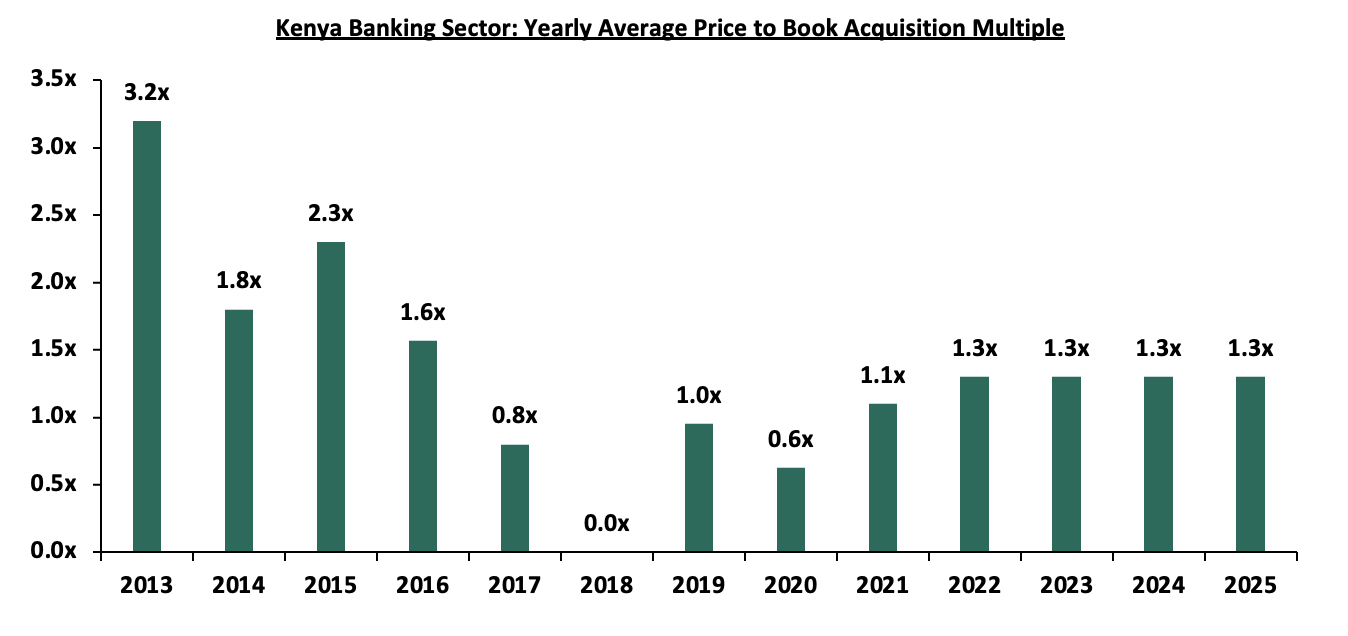
As at the end of Q1’2026, the number of commercial banks in Kenya stood at 38, same as in Q1’2025, but lower than the 43 licensed banks in FY’2015. The ratio of the number of banks per 10 million population in Kenya now stands at 6.5x, which is a reduction from 9.0x in FY’2015, demonstrating continued consolidation in the banking sector. However, despite the ratio improving, Kenya still remains overbanked as the number of banks remains relatively high compared to the African major economies. To bring the ratio to 5.6x, we ought to reduce the number of banks from the current 38 banks to about 33 banks. This is partly expected to be supported by the enactment of The Business Laws (Amendment) Act 2024 that mandated a significant increase in the minimum core capital for banks to Kshs 10.0 bn from the previous Kshs 1.0 bn that had been in effect since 2012. To facilitate compliance, lenders below this threshold were directed to incrementally grow their figure to Kshs 10.0 bn in 2032, with the phased milestones being cancelled. The new capital requirement is likely to trigger further mergers and acquisitions (M&As), especially for smaller lenders that may struggle to meet the threshold, potentially reducing the number of banks even further. However, the effect could be muted by the lifting of the moratorium which ended on 1st July 2025. The chart below shows the commercial bank ratio per 10 million people across select African nations in comparison to Kenya;

Source: World Bank, Central Bank of Kenya, South Africa Reserve Bank, Central Bank of Nigeria
The Central Bank of Kenya (CBK) ended its moratorium on licensing new commercial banks, effective July 1, 2025, a restriction that had been in place since November 2015 to support sector reforms. During the moratorium period, the banking sector strengthened through improved regulatory frameworks, greater consolidation, and the entry of strategic investors, with the number of banks declining to 38 from 43 in 2015. With the restriction lifted, new entrants can now apply for greenfield banking licenses, provided they meet the revised minimum core capital requirement of Kshs 10.0 billion. This shift reduces dependence on mergers and acquisitions as the main entry route and opens up direct market entry under stricter capital requirements.
-
Asset Quality: Asset quality for listed banks improved in Q1’2026, with the weighted average Gross Non-Performing Loan ratio (NPL) decreasing by 2.2% points to 11.8%, from 14.0% recorded in Q1’2025. The performance remained 0.2% points above the ten-year average of 11.6%. Notably, all the 10 listed banks recorded a decrease in their NPL ratios, signalling an improvement in asset quality even as credit risk remains elevated compared to historical levels, albeit showing signs of moderation following recent monetary policy easing and improving lending conditions. The overall gross non-performing loans (NPL) ratio in the banking industry however increased by 0.2% points, to 15.6% in March 2026 from 15.4% in December 2025 as a result of a higher 3.4% increase in gross NPLs compared to the 1.9% increase in gross loans during the period under review. KCB Group’s NPL ratio declined the most by 4.0% points to 15.9%, from 19.9% in Q1’2025, while HFCB Group’s NPL ratio decreased by 3.5% points to 21.7%, from 25.2% in Q1’2025. KCB’s asset quality improved due to a 15.0% increase in gross loans to Kshs 1,373.0 bn, from Kshs 1,174.8 bn recorded in Q1‘2025 compared to the 6.6% decrease in Gross non-performing loans to Kshs 217.8 bn, from Kshs 233.3 bn in Q1’2025. Similarly, HFCB Group’s asset quality improved due to a 6.5% growth in gross loans to Kshs 50.6 bn from Kshs 47.5 bn in Q1’2025, compared to the 8.4% decline in gross non-performing loans to Kshs 11.0 bn from Kshs 12.0 bn in Q1’2025. The chart below highlights the asset quality trend for the listed banks:
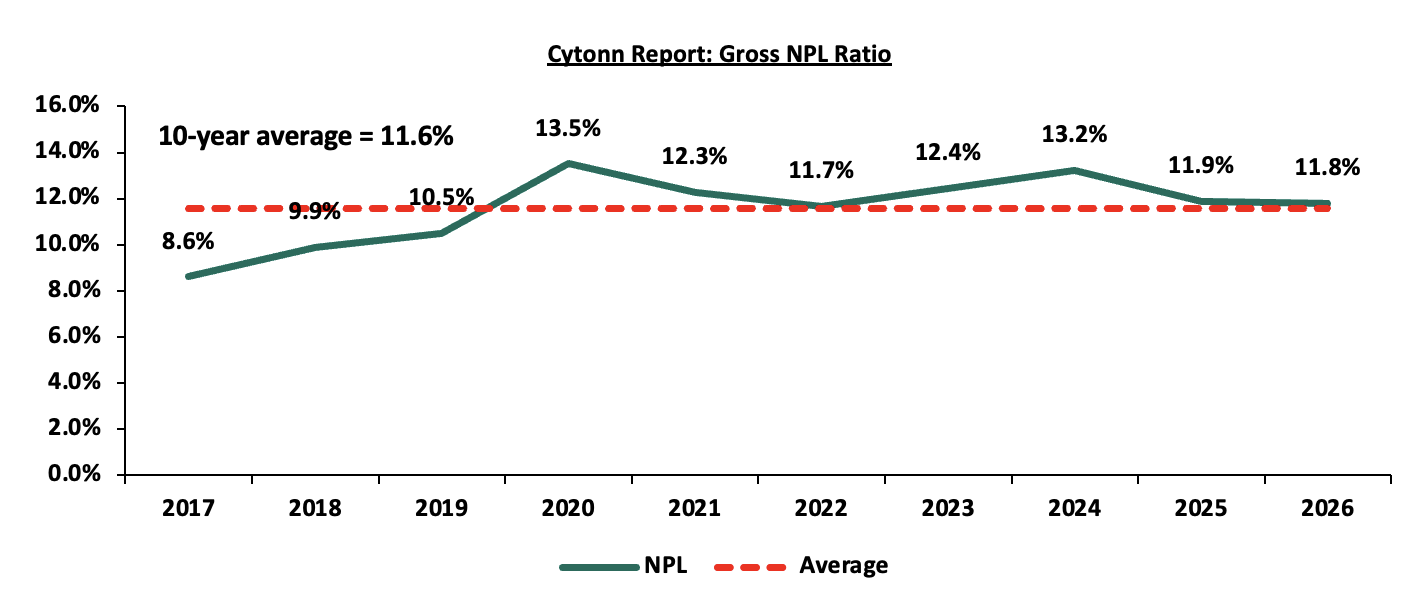
All the ten listed Kenyan banks recorded an improvement in asset quality, supported by enhanced credit risk management and early signs of economic recovery as the recent Central Bank Rate (CBR) cuts began to filter through the economy. In a bid to curb inflation and support the Shilling the Monetary Policy Committee (MPC) had adopted an accomodative monetary policy stance, lowering the Central Bank Rate (CBR) to 8.75% in March 2026 compared to 10.75% in March 2025. With commercial banks required to reflect these lower rates in their loan pricing, the banks weighted average lending rates therefore declined by 0.2% points to 14.7% in March 2026 from 14.9% in March 2025. As a result of the low interest rates, the private sector credit growth improved recording expansions of 8.1% in March 2026 and further to 9.3% in May 2026, up from an expansion of 0.2% in March 2025. The chart below shows the private sector credit growth:
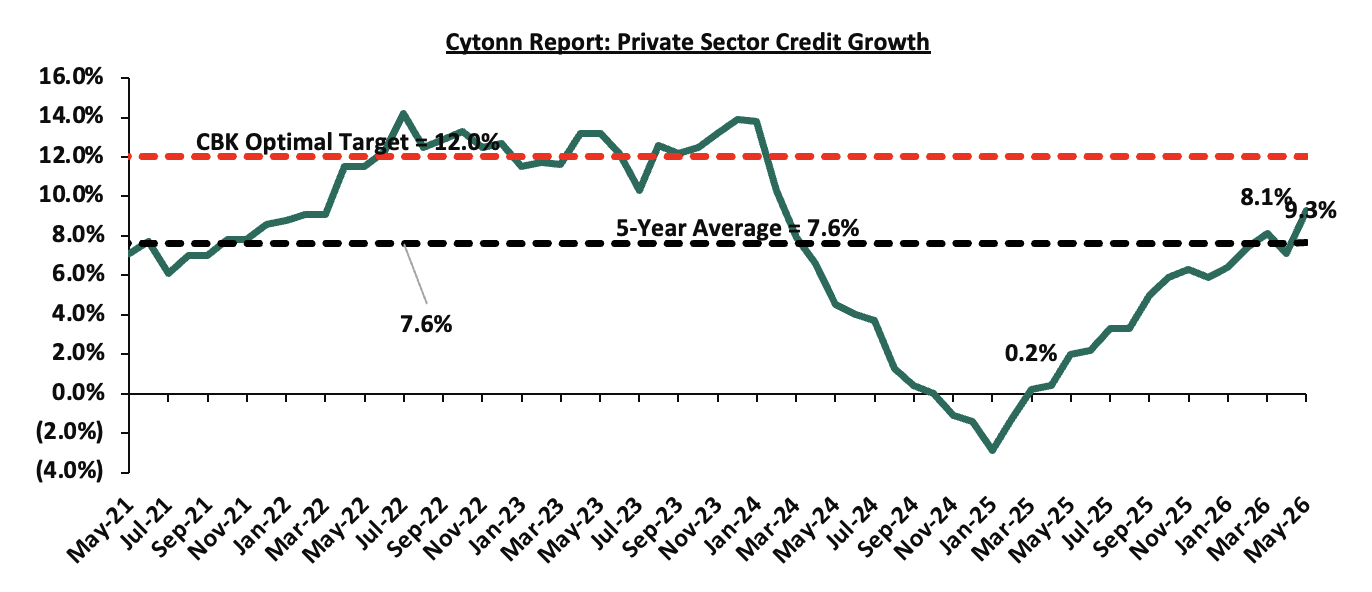
The Central Bank of Kenya had lowered the Central Bank Rate (CBR) by a cumulative 425 basis points, from 13.0% in July 2024 to 8.75% in February 2026, signalling a gradual easing of monetary policy following the successful stabilization of the currency and anchoring of inflation. However, in the April and June 2026 meeting, the MPC maintained the CBR rate at 8.75% pausing the easing cycle, to anchor inflation expectations within the 2.5%–7.5% target band while also supporting exchange rate stability. The Committee further highlighted that rising global oil prices, driven largely by geopolitical tensions in the Middle East, present upside inflation risks through potential second-round effects.
The earlier easing cycle, with the CBR cut to 8.75% from 13.00% in July 2024, had supported stronger credit demand and improved loan growth prospects as borrowing costs declined. The decision to pause now is likely to keep lending conditions steady, sustaining the recovery in credit uptake without further accelerating it, as banks continue benefiting from the prior rate cuts already transmitted into the market. Notably, growth in private sector credit grew by 9.3% in May 2026 from 8.1% in March 2026, reflecting improved demand for credit in line with the declining lending interest rates. Going forward, we expect credit risk to decline gradually as earlier interest rate easing supports stronger repayment capacity and improving credit growth. Nonetheless, the ongoing US–Iran tensions add an upside risk to credit risk through potential oil price shocks, which could reignite inflationary pressures, squeeze disposable incomes, and raise debt servicing burdens for households and corporates, slowing the pace of improvement.
The table below highlights the asset quality for the listed banking sector:
|
Cytonn Report: Listed Banks Asset Quality |
||||||
|
Bank |
Q1'2026 NPL Ratio* |
Q1'2025 NPL Ratio** |
% point change in NPL Ratio |
Q1'2026 NPL Coverage* |
Q1'2025 NPL Coverage** |
% point change in NPL Coverage |
|
KCB Group |
15.9% |
19.9% |
(4.0%) |
75.7% |
67.0% |
8.7% |
|
HFCB Group |
21.7% |
25.2% |
(3.5%) |
80.6% |
72.1% |
8.5% |
|
Equity Group |
11.5% |
15.0% |
(3.5%) |
68.5% |
60.5% |
7.9% |
|
Standard Chartered Bank |
5.2% |
8.3% |
(3.1%) |
85.5% |
78.7% |
6.8% |
|
Co-operative Bank |
14.7% |
17.1% |
(2.4%) |
67.7% |
64.2% |
3.5% |
|
I&M Group |
9.1% |
10.9% |
(1.8%) |
73.4% |
63.6% |
9.8% |
|
Absa Bank Kenya |
11.6% |
13.1% |
(1.5%) |
66.6% |
65.2% |
1.4% |
|
Diamond Trust Bank |
11.8% |
13.2% |
(1.5%) |
56.1% |
39.9% |
16.2% |
|
NCBA Group |
11.2% |
12.2% |
(0.9%) |
66.2% |
63.0% |
3.2% |
|
Stanbic Holdings |
8.4% |
8.7% |
(0.4%) |
85.4% |
80.8% |
4.6% |
|
Mkt Weighted Average* |
11.8% |
14.0% |
(2.2%) |
72.1% |
66.3% |
5.7% |
|
*Market cap weighted as at 19/06/2026 |
||||||
|
**Market cap weighted as at 13/06/2025 |
||||||
Key take-outs from the table include;
-
Asset quality for the listed banks improved in Q1’2026, with market weighted average NPL decreasing by 2.2% points to 11.8% from 14.0% in Q1’2025. The improvement in the asset quality was mainly driven by an Improvement in KCB Group, HFCB Group, Equity Group, Standard Chartered Bank and Co-operative Bank asset quality with their NPL ratio decreasing by 4.0%, 3.5%, 3.5%, 3.1% and 2.4% points respectively,
-
KCB Group and HFCB Group had the highest NPL ratio declines by 4.0% and 3.5% points respectively to 15.9% and 21.7%, from 19.9% and 25.2% respectively in Q1’2025. KCB’s asset quality improved due to a 15.0% increase in gross loans to Kshs 1,373.0 bn, from Kshs 1,174.8 bn recorded in Q1‘2025 compared to the 6.6% decrease in Gross non-performing loans to Kshs 217.8 bn, from Kshs 233.3 bn in Q1’2025. Similarly, HF Group’s asset quality improved due to a 6.5% growth in gross loans to Kshs 50.6 bn from Kshs 47.5 bn in Q1’2025, compared to the 8.4% decline in gross non-performing loans to Kshs 11.0 bn from Kshs 12.0 bn in Q1’2025, and,
-
Market weighted average NPL Coverage for the listed banks increased by 5.7% points to 72.1% in Q1’2026, from 66.3% recorded in Q1’2025, majorly on the back of increased NPL coverage recorded by Diamond Trust Bank Kenya, I&M Group, KCB Group, HFCB Group, Equity Group, Standard Chartered Group, Stanbic Holdings, Co-operative Bank, NCBA Group and ABSA Kenya by 16.2%, 9.8%, 8.7%, 8.5%, 7.9%, 6.8%, 4.6%, 3.5%, 3.2% and 1.2% points respectively in Q1’2026.
Section II: Summary of the Performance of the Listed Banking Sector in Q1’2026:
The table below highlights the performance of the banking sector, showing the performance using several metrics, and the key take-outs of the performance;
|
Cytonn Report: Kenyan Listed Banks Performance Q1’2026 |
|||||||||||||||
|
Bank |
Core EPS Growth |
Interest Income Growth |
Interest Expense Growth |
Net Interest Income Growth |
Net Interest Margin |
Non-Funded Income Growth |
NFI to Total Operating Income |
Growth in Total Fees & Commissions |
Deposit Growth |
Growth in Government Securities |
Loan to Deposit Ratio |
Loan Growth |
Return on Average Equity |
COF |
YIEA |
|
HF Group |
67.0% |
14.3% |
(2.4%) |
27.9% |
6.8% |
33.9% |
31.0% |
1.9% |
30.7% |
64.9% |
63.8% |
7.4% |
9.1% |
5.2% |
11.3% |
|
Equity Group |
24.0% |
4.6% |
(19.1%) |
15.6% |
7.9% |
13.7% |
40.3% |
27.4% |
12.6% |
7.5% |
59.0% |
8.6% |
27.4% |
3.0% |
10.5% |
|
Co-operative Bank |
21.3% |
4.8% |
(8.3%) |
12.2% |
8.9% |
16.3% |
33.6% |
14.4% |
16.6% |
12.7% |
71.3% |
13.6% |
18.9% |
4.7% |
13.0% |
|
I&M Group |
19.4% |
19.3% |
1.2% |
31.1% |
8.6% |
7.1% |
23.8% |
-5.1% |
25.8% |
97.5% |
63.1% |
10.0% |
17.4% |
4.5% |
12.7% |
|
KCB Group |
10.0% |
2.1% |
(11.1%) |
8.6% |
8.5% |
8.3% |
31.7% |
6.7% |
15.7% |
18.5% |
73.1% |
18.6% |
21.6% |
3.6% |
11.8% |
|
NCBA Group |
8.8% |
3.0% |
(23.3%) |
22.0% |
7.7% |
6.3% |
39.2% |
6.6% |
9.8% |
15.6% |
59.6% |
13.0% |
19.1% |
4.2% |
11.5% |
|
Diamond Trust Bank |
7.7% |
10.3% |
(12.2%) |
30.9% |
7.0% |
(3.2%) |
22.6% |
2.1% |
10.4% |
16.7% |
63.2% |
13.8% |
11.4% |
5.0% |
11.7% |
|
Stanbic Group |
5.5% |
4.7% |
(6.4%) |
11.7% |
5.7% |
(13.7%) |
23.9% |
4.0% |
21.7% |
73.5% |
62.8% |
5.8% |
19.6% |
3.6% |
10.0% |
|
Absa Bank Kenya |
(13.9%) |
(10.2%) |
(17.1%) |
(7.9%) |
8.7% |
(5.2%) |
29.2% |
9.6% |
7.5% |
21.2% |
76.1% |
(1.5%) |
21.4% |
3.2% |
11.5% |
|
Standard Chartered Bank |
(26.3%) |
(22.3%) |
(15.1%) |
(23.3%) |
7.9% |
10.3% |
37.3% |
21.9% |
12.6% |
5.0% |
51.5% |
20.0% |
19.6% |
1.2% |
9.0% |
|
Q1'2026 Mkt Weighted Average* |
9.4% |
1.4% |
(13.3%) |
10.0% |
8.0% |
7.1% |
33.3% |
12.4% |
14.6% |
24.9% |
65.1% |
11.2% |
21.1% |
3.5% |
11.3% |
|
Q1'2025 Mkt Weighted Average* |
(0.7%) |
(1.4%) |
(14.4%) |
7.9% |
8.0% |
(11.2%) |
33.6% |
0.9% |
0.6% |
30.2% |
66.5% |
(2.3%) |
21.7% |
5.0% |
12.6% |
|
*Market cap weighted as at 19/06/2026 |
|||||||||||||||
|
**Market cap weighted as at 13/06/2025 |
|||||||||||||||
Key takeaways from the table include:
-
The listed banks recorded a 9.4% growth in core Earnings per Share (EPS) in Q1’2026, compared to the weighted average decline of 0.7% in Q1’2025, an indication of a strong performance on the back of a 7.1% growth in non-funded income in Q1’2026, compared to a decline of 11.2% in Q1’2025. This was majorly attributable to an increase in the fees and commissions income which increased by 11.5% points to 12.4% in Q1’2026 from 0.9% in Q1’2025. The performance during the period highlights banks’ reduced reliance on interest income as reflected in the faster increase in the non-funded income weighted average growth to 7.1% from a decline of 11.2% in Q1’2025 compared to a marginal increase in net interest income weighted average growth to 10.0% from 7.9% in Q1’2025 that resulted in a recovery in earnings growth,
-
Investments in government securities investments by listed banks decreased in Q1’2026, having recorded a market-weighted average growth of 24.9%, from the 30.2% growth recorded in Q1’2025, with all of the listed banks recording increases in government securities investments. The increase was as a result of banks deploying excess liquidity into safe, attractive government securities, while the decline in treasury bonds yields in Q1’2026 also boosted the market value of existing bonds, generating capital gains and reinforcing the appeal of holding government debt. I&M Group and Stanbic group recorded the largest increases of 97.5% and 73.5% respectively,
-
The listed banks’ Net loans and advances to customers recorded a weighted average growth of 11.2% in Q1’2026, an increase from the 2.3% decline recorded in Q1’2025, indicating increased lending activity supported by easing borrowing costs, as a result of declining lending interest rates,
-
Interest income recorded a weighted average increase of 1.4% in Q1’2026, compared to a decline of 1.4% in Q1’2025. Similarly, interest expenses recorded a market-weighted average decline of 13.3% in Q1’2026 compared to a decline of 14.4% in Q1’2025. Consequently, net interest income recorded a weighted average growth of 10.0% in Q1’2026, slightly higher than the 7.9% growth recorded in Q1’2025, on the back of easing monetary policy leading to lower lending and deposit rates,
-
Notably, non-funded income growth improved during the year, as evidenced by non-funded income weighted average growth of 7.1% in Q1’2026 compared to a weighted average decline of 11.2% in Q1’2025. Additionally, listed banks recorded a weighted average growth of 12.4% in total fees and commissions income in Q1’2026 compared to a weighted growth of 0.9% in Q1’2025, and,
-
The listed banks recorded a 21.1% weighted average growth on return on average equity (RoaE), 0.6% points lower than the 21.7% growth registered in Q1’2025. Similarly, the entire banking sector’s Return On Equity (ROE) stood at 22.2% as of December 2025, unchanged from September 2025 and a 0.2% points increase from the 22.0% recorded in December 2024 . On a global level, the Kenyan banking sector continues to record high profitability compared to other economies in the world, as highlighted in the chart below:

Source: Cytonn research
* Figure as of December 2025
Section III: The Focus Areas of the Banking Sector Players Going Forward:
The banking sector witnessed an upturn in profitability during the period under review, with the Core Earnings Per Share (EPS) increasing by 9.4% compared to the 0.7% decline registered last year in a similar period, this is primarily due to an increase in non-funded income growth to 7.1% in Q1’2026, compared to a decline of 11.2% in Q1’2025. This was majorly attributable to higher transaction volumes which supported fees and commissions income. Notably, three of the ten listed banks recorded a decline in non-funded income in Q1’2026. This concentration has exposed banks to earnings pressure in an increasingly interest-rate-sensitive environment. While there were expectations of an improved operating environment following continued monetary policy easing, evidenced by a lower Central Bank Rate (CBR) of 9.0% as of December 2025 and 8.75% as of June 2026, and a relatively volatile Shilling, the broader economic performance has yet to translate into meaningful revenue diversification or asset quality improvement.
Consequently, profitability remains constrained, and it is uncertain whether banks will reduce provisioning levels in the near term. Any moderation in provisioning will largely depend on sustained economic recovery and a material easing of credit risk. Notably, general provisions among listed banks recorded a weighted decline of 2.0% in Q1’2026, compared to a growth of 6.5% in Q1’2025, indicating that banks have started to decrease their provisioning to cushion themselves from credit risk due to the more accommodative monetary policy stance. However, the escalation of geopolitical tensions, particularly the US–Iran conflict, could reverse this trend by heightening inflationary pressures through oil price shocks, weakening borrower repayment capacity, and potentially prompting banks to maintain higher precautionary provisioning levels. Based on the current operating environment, we believe the future performance of the banking sector will be shaped by the following key factors:
-
Growth in Interest income: Going forward, we expect interest income growth to remain a key driver in the banking industry. With the recent easing of monetary policy by the Central Bank of Kenya, which lowered the Central Bank Rate (CBR) by 25.0 basis points to 8.75% in February 2026 and maintained in the April and June 2026 MPC meetings, signals a gradual reduction in borrowing costs. This is likely to support an increase in credit uptake, expanding banks' loan books and consequently boosting interest income. Additionally, the continued use of banks' risk-based lending models will enable banks to effectively price their risk, further contributing to the growth of interest income.,
-
Revenue Diversification: In Q1’2026, non-funded income (NFI) recorded a 7.1% weighted average growth, compared to the 11.2% weighted decline in Q1’2025. The growth in fees and commissions income, one of the key components of NFI, contributed to the strong performance, with growth increasing to 12.4% in Q1’2026 from 0.9% in Q1’2025, reflecting strong transactional volumes and a potential tapering in digital revenue momentum. Notably, this deceleration occurred with 3 of the 10 listed Banks recording a decrease in their non-funded income. As a result of the decline in non-funded income (NFI) the weighted average contribution of NFI to total operating income came in at 33.3% in Q1’2026, 0.3% points lower than the 33.6% weighted average contribution recorded in Q1’2025 and as such, there still exists an opportunity for the sector to further increase NFI contributions to revenue given the continuous adoption of digitization,
-
Growth in Loans and Advances: All the 10 listed banks recorded growth in loans and advances to customers, resulting in a weighted average growth in loans of 11.2% relative to the 2.3% decline recorded in a similar period in 2025. The MPC’s decision to maintain the CBR at 8.75% in June 2026, after prior easing, signals a pause in the monetary policy easing cycle. This is likely to stabilize borrowing costs at their current lower levels rather than drive further declines, meaning credit growth will continue to benefit from earlier rate cuts but without additional near-term stimulus from policy easing. As a result, loan growth should remain supported by improved affordability and stronger private sector demand, but its pace may moderate compared to a scenario of continued rate reductions. To drive further loan growth, banks must leverage opportunities such as risk-based lending models, improved customer segmentation, and expanding access to credit in underserved sectors, and,
-
Regional Expansion and Further Consolidation: Consolidation remains a key theme going forward with the current environment offering opportunities for larger banks with a sufficient capital base to expand and take advantage of the market's low valuations, as well as further consolidate out smaller and weaker banks. Notably, the majority of the bigger banks have continued to cushion over unsystematic risks specific to the local market by expanding their operations into other African nations. Banks such as KCB and Equity Group have been leveraging on expansion and consolidation, which has largely contributed to their increased asset base as well as earnings growth. Additionally, we expect the increased capital requirements imposed on banks to further accelerate consolidation, as only well-capitalized banks are able to meet these thresholds while pursuing expansion opportunities. As such, we expect to see a continued expansion trend aimed at revenue optimization.
-
Geopolitical Tensions: Geopolitical tensions stemming from the US–Iran conflict are likely to weigh on the Kenyan banking sector through higher global oil prices, which feed into domestic inflation and raise the cost of living, thereby pressuring borrowers’ repayment capacity and elevating credit risk. This environment may also dampen economic activity and investor sentiment, leading to more cautious lending behaviour, slowed credit growth, and a preference by banks to hold higher precautionary buffers in anticipation of potential asset quality deterioration. In addition, the resulting external shocks could weaken the Kenyan shilling through a wider current account deficit and higher import costs, negatively affecting banks by increasing the cost of servicing foreign currency liabilities, heightening FX-related credit risk for unhedged borrowers, and amplifying volatility in foreign currency income and balance sheet valuations.
Section IV: Brief Summary and Ranking of the Listed Banks:
As per our analysis of the banking sector from a franchise value and a future growth opportunity perspective, we carried out a comprehensive ranking of the listed banks. For the franchise value ranking, we included the earnings and growth metrics as well as the operating metrics shown in the table below in order to carry out a comprehensive review of the banks:
|
Cytonn Report: Listed Banks Earnings, Growth and Operating Metrics Q1’2026 |
||||||||
|
Bank |
Loan to Deposit Ratio |
Cost to Income (With LLP) |
Return on Average Capital Employed |
Deposits/ Branch (bn) |
Gross NPL Ratio |
NPL Coverage |
Tangible Common Ratio |
Non Funded Income/Revenue |
|
Absa Bank |
76.1% |
48.9% |
21.4% |
4.5 |
11.6% |
66.6% |
18.4% |
29.2% |
|
KCB Group |
73.1% |
54.5% |
21.6% |
3.6 |
15.9% |
75.7% |
15.0% |
31.7% |
|
Coop Bank |
71.3% |
53.0% |
18.9% |
2.8 |
14.7% |
67.7% |
19.2% |
33.6% |
|
HFCB Group |
63.8% |
66.9% |
9.1% |
3.0 |
21.7% |
80.6% |
20.0% |
31.0% |
|
DTBK |
63.2% |
62.8% |
11.4% |
3.3 |
11.8% |
56.1% |
15.8% |
22.6% |
|
I&M Holdings |
63.1% |
61.3% |
17.4% |
4.3 |
9.1% |
73.4% |
15.8% |
23.8% |
|
Stanbic Bank |
62.8% |
50.5% |
19.6% |
13.7 |
8.38% |
85.4% |
13.2% |
23.9% |
|
NCBA Group |
59.6% |
61.2% |
19.1% |
4.4 |
11.2% |
66.2% |
17.2% |
39.2% |
|
Equity Bank |
59.0% |
55.7% |
27.4% |
3.6 |
11.5% |
68.5% |
15.2% |
40.3% |
|
SCBK |
51.5% |
49.3% |
19.6% |
14.6 |
5.2% |
85.5% |
15.7% |
37.3% |
|
Weighted Average Q1'2026 |
65.1% |
54.7% |
21.1% |
5.5 |
11.8% |
72.1% |
16.3% |
33.3% |
|
Market cap weighted as at 9/06/2026 |
||||||||
The overall ranking was based on a weighted average ranking of Franchise value (accounting for 60.0%) and intrinsic value (accounting for 40.0%). The Intrinsic Valuation is computed through a combination of valuation techniques, with a weighting of 40.0% on Discounted Cash-flow Methods, 35.0% on Residual Income, and 25.0% on Relative Valuation, while the Franchise ranking is based on a bank’s operating metrics, meant to assess efficiency, asset quality, diversification, and profitability, among other metrics. The overall Q1’2026 ranking is as shown in the table below:
|
Cytonn Report: Listed Banks Q1’2026 Rankings |
|||||
|
Bank |
Franchise Value Rank |
Intrinsic Value Rank |
Weighted Rank Score |
Q1'2025 Rank |
Q1'2026 Rank |
|
Absa Bank |
1 |
2 |
1.4 |
2 |
1 |
|
KCB Group |
3 |
3 |
3.0 |
3 |
2 |
|
SCBK |
2 |
8 |
4.4 |
1 |
3 |
|
NCBA Group |
7 |
1 |
4.6 |
8 |
4 |
|
Equity Bank |
4 |
6 |
4.8 |
6 |
5 |
|
Coop Bank |
6 |
5 |
5.6 |
4 |
6 |
|
I&M Holdings |
5 |
9 |
6.6 |
5 |
7 |
|
DTBK |
9 |
4 |
7.0 |
9 |
8 |
|
HFCB Group |
10 |
7 |
8.8 |
10 |
9 |
|
Stanbic Bank |
8 |
10 |
8.8 |
7 |
9 |
Major Take-outs from the Q1’2026 Ranking are:
-
Absa Bank climbed up to position 1 in Q1’2026 from position 2 in Q1’2025, mainly supported by strong franchise value score and intrinsic value score, attributable to decrease in the cost to income ratio by 5.7% points to 46.7% in Q1’2026, from 52.3% in Q1’2025 coupled with a decrease in the bank’s return on average equity ratio by 2.4% points to 24.7% in Q1’2026 from 27.0% in Q1’2025,
-
NCBA was the most improved as it climbed up 4 places to position 4 from position 8 in Q1’2025, mainly supported by improved franchise value score and intrinsic value score. This was mainly attributable to a 22.0% increase in Net Interest Income to Kshs 12.2 bn in Q1’ 2026 from Kshs 10.0 bn in Q1’ 2025. Notably, its Net Interest Margin increased by 1.5% points to 7.7% from 6.3% in Q1’2025
-
Stanbic slid 2 places to rank at position 9 tying with HFCB Group in Q1’2026, down from position 7 in Q1’2025, attributable a decline in intrinsic value score and the franchise value score mainly on the back of 1.4% points decline in Return on average equity to 19.6% in Q1’2026 from the 20.0% recorded in Q1’2025, coupled with the 1.2% points decrease in its cost to income without LLPs to 47.0% in Q1’2026, from 48.2% in Q1’2025.
For more information, see our Cytonn Q1’2026 Listed Banking Sector Review full report.
Disclaimer: The views expressed in this publication are those of the writers where particulars are not warranted. This publication, which is in compliance with Section 2 of the Capital Markets Authority Act Cap 485A, is meant for general information only and is not a warranty, representation, advice, or solicitation of any nature. Readers are advised in all circumstances to seek the advice of a registered investment advisor.

- Talk to us
- Kenya
- P.O Box 20695 - 00200, Nairobi, Kenya
- Cell +254709101200
- Tel +254709101200
- WhatsApp +254741676635
- United States
- +254709101200
- DOWNLOAD OUR APP
-


- Kenya
- 8th Floor, Pinetree Plaza, Kaburu Drive, Ngong Road, Nairobi, Kenya
- USA
- Suite 1150, 1775 Eye Street NW, USA, Washington DC 20006, USA
- Investments
- High Yield
- Private Equity
- Real Estate
- Real Estate
- RiverRun Estates
- Cytonn Towers
- The Ridge
- Taraji Heights
- The Alma